


In the present day, we’re asserting assist for time sequence collections on the following technology of Amazon OpenSearch Serverless. With time sequence collections, you may ingest, retailer, and analyze logs, metrics, traces, and occasion knowledge with out provisioning or managing clusters. Time sequence collections take in ingest spikes routinely, maintain latest knowledge quick to question, and make months or years of historical past searchable at low price, all in the identical assortment. Time sequence collections additionally convey alerting and anomaly detection to OpenSearch Serverless, so you could find and act on issues as they occur. With assist for as much as 100 TB of sizzling storage per assortment, they’re constructed for high-scale observability workloads resembling software monitoring, safety analytics, and IoT telemetry.
Observability knowledge is voluminous, and it surges sharply throughout occasions like dangerous deployments and outages, proper when groups want solutions quickest. An undersized cluster falls behind and delays the very logs engineers are ready for, so groups measurement for the worst day and pay for that capability each different day. Scorching storage will get costly as historical past grows, so groups lower retention or transfer older knowledge to snapshots that somebody should restore earlier than operating a question. Clusters additionally want fixed tuning and capability planning, which pulls engineers away from the investigations the information is supposed to assist. Each determination turns into a tradeoff between price, retention, and the way rapidly you may reply questions on your programs.
Time sequence collections on OpenSearch Serverless take away that tradeoff. When an incident drives a surge in log quantity, compute scales in seconds to maintain up, so the logs engineers are ready for arrive on time. When visitors settles, compute scales again down, all the way in which to zero, so that you cease paying for worst-day capability. Older knowledge strikes to a lower-cost heat tier and stays queryable, so you may maintain years of historical past with out chopping retention or restoring snapshots. There aren’t any clusters to measurement or tune. You set compute limits and some index settings, and the service handles the remaining.
Pay much less for the information you question much less
Most queries in opposition to time sequence knowledge goal the previous few hours or days, whereas older knowledge is much less incessantly queried however nonetheless must be accessible. With the brand new index.heat.after setting, you resolve how lengthy knowledge stays within the sizzling tier earlier than it strikes to the lower-cost heat tier. You’ll be able to set it in days or hours, from a minimal of 1 day (24h or 1d) as much as 10 years (3650d), and it may well’t exceed the index’s retention interval. When you don’t set it, knowledge strikes to heat after 1 day.
At ingest, every doc is written to a low-latency sizzling tier and to Amazon Easy Storage Service (Amazon S3). As knowledge reaches the age you set, oldest first, the new copy is launched and the information lives within the heat tier on Amazon S3. When a question wants heat knowledge, the service hundreds that knowledge again into the new tier to serve it. The primary question on that knowledge takes longer, and later queries on the identical knowledge run at hot-tier latency. That fits investigations and reporting over older knowledge, the place the identical time vary is commonly queried repeatedly. When a question spans each tiers, outcomes come again in a single response. You pay sizzling storage charges just for knowledge within the sizzling tier.
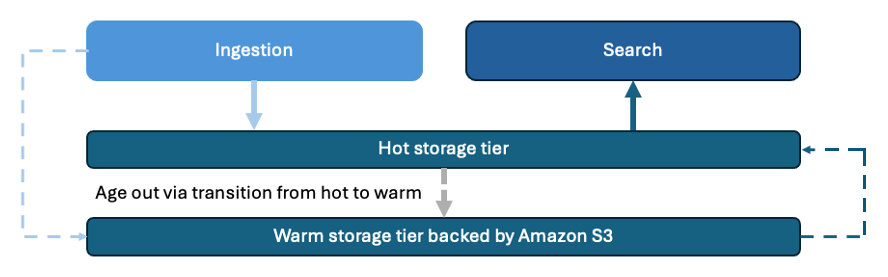
Determine 1: Information strikes from the new tier to the nice and cozy tier after 7 days, continued to Amazon S3 all through
Retain knowledge for so long as your workload requires
Retention is ready on the index itself, so there is no such thing as a separate lifecycle coverage to create or keep. Set index.knowledge.retention in an index template, and each index that matches the sample inherits it. You’ll be able to retain knowledge for anyplace from 1 day to three,650 days (10 years), specified as an entire variety of days.
Tiering and retention are impartial. Tiering controls question velocity and value, and retention controls when knowledge is deleted. For instance, you may maintain software logs sizzling for 7 days and retain them for 30 days, or maintain audit knowledge within the heat tier for years to satisfy compliance necessities. When an audit comes up, you question that historical past in the identical assortment, and search compute scales as much as deal with the additional load. There isn’t any snapshot restore and no forensic cluster to face up.
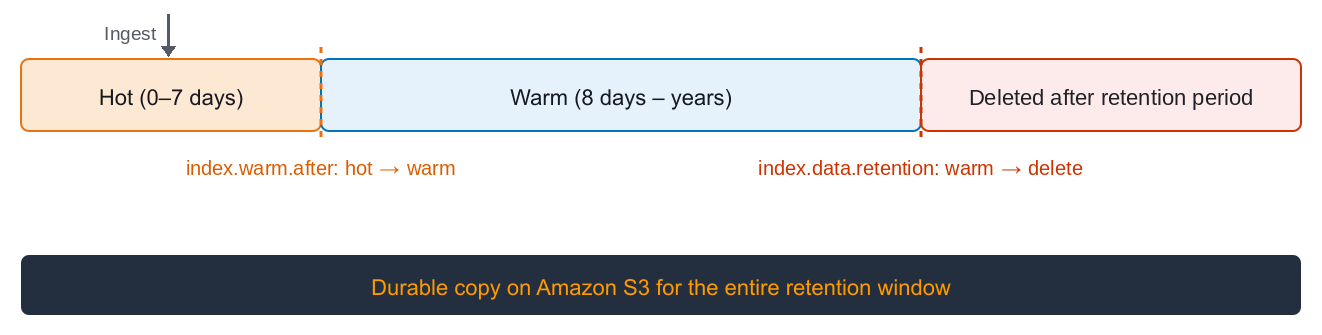
Determine 2: Information tiering and retention
Designate the occasion timestamp for every index
Each doc in a time sequence assortment should now embrace a timestamp subject. Every index has one designated time subject that the service makes use of to arrange and type your knowledge, and paperwork with a lacking, null, or invalid timestamp are rejected.
By default, the time subject is @timestamp. In case your occasions already carry a distinct subject, resembling event_time, set index.timestamp_field whenever you create the index or in an index template, so that you don’t want to alter your producers. The sector should be a top-level date subject, and a doc’s timestamp can’t be modified after it’s listed.
Rejections apply to particular person paperwork, not entire requests. In a _bulk request, the legitimate paperwork are listed and the rejected ones are listed within the errors block of the response, so one dangerous file doesn’t fail the batch.
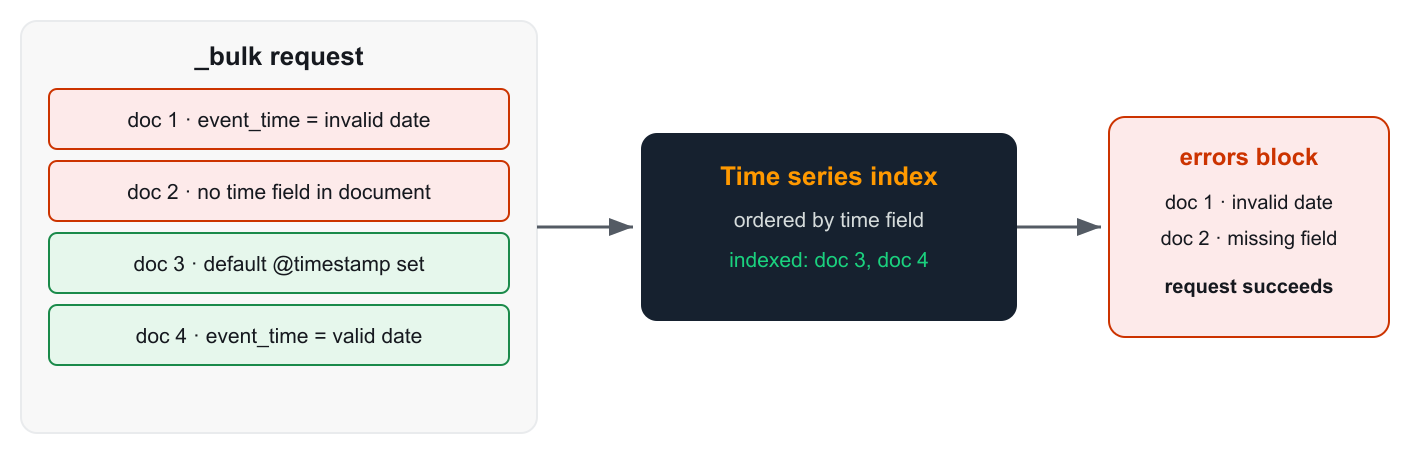
Determine 3: How the time subject determines whether or not every doc is listed or rejected
Catch issues earlier than they turn into outages
Time sequence collections now assist alerting and anomaly detection, which Basic serverless collections didn’t supply. As an alternative of counting on a separate system to let you know when one thing breaks, you may monitor, detect, and notify from the gathering that shops your knowledge. Now, operations groups can get notified when error charges or latency spike, safety groups can catch a burst of failed logins, and enterprise groups can spot a sudden drop in orders.
Alerting displays question your knowledge on a schedule and notify you thru the channel you select when a situation is met. Per-query displays alert on a single worth, resembling common latency crossing a threshold. Per-bucket displays consider every group individually, resembling each host whose error fee climbs too excessive. PPL displays deal with extra complicated logic in Piped Processing Language (PPL).
Anomaly detection makes use of the Random Minimize Forest (RCF) machine studying algorithm to study your knowledge’s regular sample and flag deviations in close to actual time, with no mounted thresholds to guess. Level a monitor on the detector’s outcomes to get notified the second an anomaly seems.
You handle displays and detectors in OpenSearch UI workspaces, the place entry follows the workspace’s collaborator permissions. Learn-only collaborators can view displays and alerts, whereas learn/write and admin collaborators may create, replace, and acknowledge them. The Observability workspace places alerts alongside dashboards and PPL queries, so your crew can go from an alert to the occasions behind it, throughout serverless collections and present Amazon OpenSearch Service domains.
Getting began
For a single-click expertise, use Categorical Create within the Amazon OpenSearch Service console. It units up the gathering group, encryption, community entry, and knowledge entry for you. To regulate every step your self, use the AWS Command Line Interface (AWS CLI) as proven within the following steps.
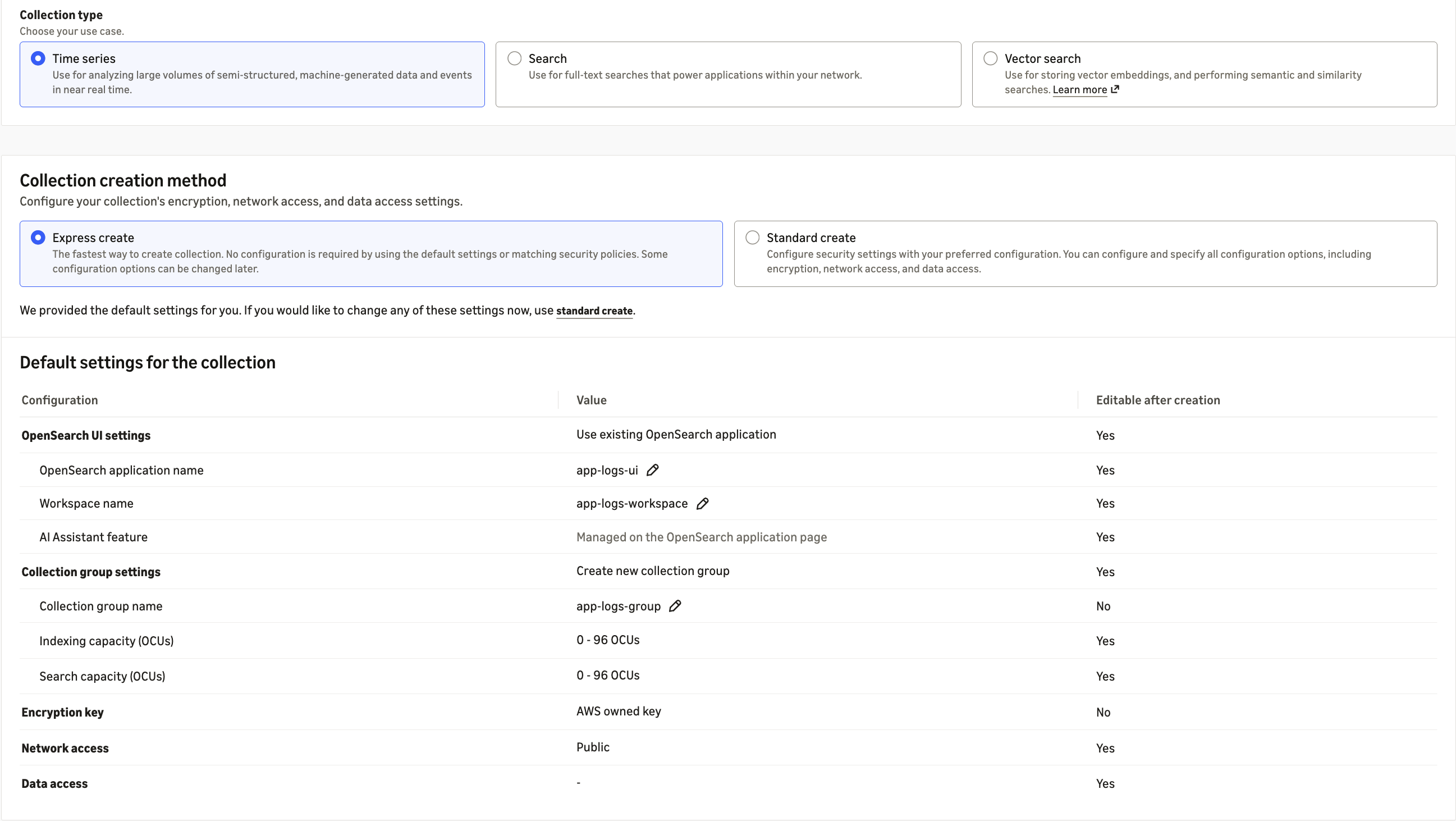
Determine 4: Categorical Create units up the gathering group, encryption, and community entry with default settings
First, create a next-generation assortment group. The gathering group units the compute limits that every one of its collections share. A minimal of 0 OpenSearch Compute Models (OCUs) lets the group scale to zero when it’s idle, and the utmost caps your spend.
Subsequent, create a community coverage to regulate the place the gathering may be reached from, and a knowledge entry coverage to regulate which AWS Identification and Entry Administration (IAM) principals can learn and write knowledge.
Then create the time sequence assortment within the assortment group:
After the gathering is energetic, create an index template with the time subject, tiering, and retention settings that suit your workload. Each index whose title matches the sample picks up these settings routinely:
Lastly, ingest your knowledge into the gathering, then open the Observability workspace in OpenSearch UI to construct your first dashboards, displays, and anomaly detectors.
Now accessible
Time sequence collections can be found at present in all AWS industrial Areas the place the following technology of OpenSearch Serverless is accessible. You pay for the compute you employ in OCUs, and for warm and heat storage in GB-month. For pricing particulars, go to the Amazon OpenSearch Service pricing web page.
To study extra, go to the Amazon OpenSearch Serverless product web page and the Amazon OpenSearch Serverless Developer Information.
Give it a strive within the Amazon OpenSearch Service console, and ship suggestions by AWS re:Publish or your standard AWS Assist contacts.
In regards to the creator