


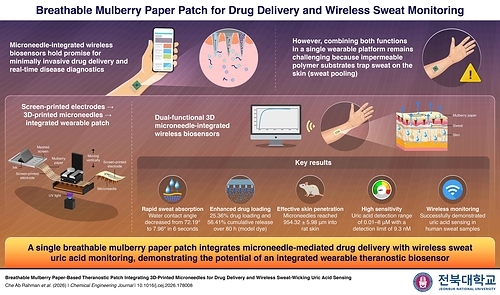
A staff at Jeonbuk Nationwide College (JBNU) has constructed a wearable patch on conventional Korean mulberry paper (hanji). It carries 3D printed microneedles for drug supply and printed electrodes that wirelessly observe uric acid in sweat. Uric acid is the biomarker medical doctors use to handle gout and hyperuricemia.
The microneedles have been made with a light-based printing course of and stuck to the paper with no adhesive. They held about twice as a lot drug as an unmodified design. The sensor detected uric acid at nanomolar concentrations, and its readings matched laboratory devices. Professor Sooman Lim led the examine, which is printed in Chemical Engineering Journal, with Aqila Che Ab Rahman and Habibulla Imran as joint first authors.
Adhesive-Free Printing on a Porous Sheet
Attaching inflexible microstructures to a versatile, fibrous sheet usually requires a bonding layer. The JBNU staff as an alternative cured the needles in place on the hanji. After optimization, the needles carried a drug load of 25.36%, in contrast with 12.6% for the baseline model. They launched a mannequin dye regularly, discharging simply over half of it (56.41%) throughout 80 hours. On excised rat pores and skin, the needles reached a depth of roughly 954 micrometers and stored their form.
The staff selected paper over plastic movie due to sweat. Polymer-backed patches can maintain moisture towards the pores and skin, which irritates it and makes sweat sampling more durable. Hanji’s fiber community wicks liquid away as an alternative. A water droplet on its floor went from a contact angle of 72.19° to 7.96° in six seconds.
Lab-Matched Readings from Sweat
Monitoring uric acid at present depends on blood checks, so a sweat-based patch provides a needle-free path to house monitoring. The printed electrochemical sensor coated a variety of 0.01 to eight micromolar and will detect concentrations as little as 9.3 nanomolar. The staff checked it towards liquid chromatography-mass spectrometry (LC-MS) utilizing each buffer resolution and actual sweat. It recovered between 98.1% and 101.3% of the identified quantities.
The machine additionally carried out properly in sensible checks. Its floor dried in 13 seconds, it gave the identical outcomes over three repeat measurements, and its wi-fi hyperlink drew solely 15 mW.
One Substrate, Two Separate Checks
The supply and sensing capabilities haven’t but operated collectively on a dwelling physique. Every was examined by itself.
“Our findings reveal the potential of mixing microneedle-based supply and wi-fi sweat sensing on a single breathable substrate. Though we evaluated these capabilities individually, the outcomes present a basis for future gadgets that would combine remedy and real-time well being monitoring,” explains Professor Lim.
Subsequent, the group plans to interchange the mannequin dye with medical medication, run skin-safety research and trial the patch on the physique in actual time.
Printing Remedy and Diagnostics into One Wearable
Lim’s lab has labored on printed wearables earlier than. Working with Wuhan Chamtop, it 3D printed stress sensors from a barium titanate and PVDF composite that energy themselves from the power of physique motion. The paper patch extends that work from sensing into remedy. It addresses wearer consolation and the separation between monitoring a situation and treating it.
Printed microneedles are a rising subject. Queen’s College Belfast developed a dissolvable pores and skin most cancers patch. Its staff blended two anti-cancer compounds into the resin earlier than printing, so the medicine runs by means of every needle as an alternative of coating its floor. Earlier, Stanford College and UNC Chapel Hill used Carbon’s CLIP course of to print a microneedle vaccine patch. It produced roughly ten occasions the immune response of an intramuscular shot.
Different teams are already pairing sensing with supply. A staff with contributors from West China Hospital of Sichuan College and The Chinese language College of Hong Kong constructed a closed-loop wound dressing. It makes use of barbed printed needles, with strong ones performing as electrodes that learn tissue impedance and hole ones carrying medicine. In Greece, researchers on the Nationwide and Kapodistrian College of Athens printed an electrochemical ring that reads glucose from sweat and shows it on a smartphone.
JBNU’s contribution is the substrate itself. A breathable paper base makes long-wear theranostic patches extra life like. Built-in on-body testing will determine whether or not it reaches sufferers.
To remain updated with the most recent 3D printing information, don’t overlook to subscribe to the 3D Printing Business e-newsletter or observe us on LinkedIn.
Discover the total Way forward for 3D Printing and Government Survey collection from 3D Printing Business, that includes views from CEOs, engineers, and business leaders on the industrialization of additive manufacturing, 3D printing business developments 2026, qualification, provide chains, and additive manufacturing business evaluation.
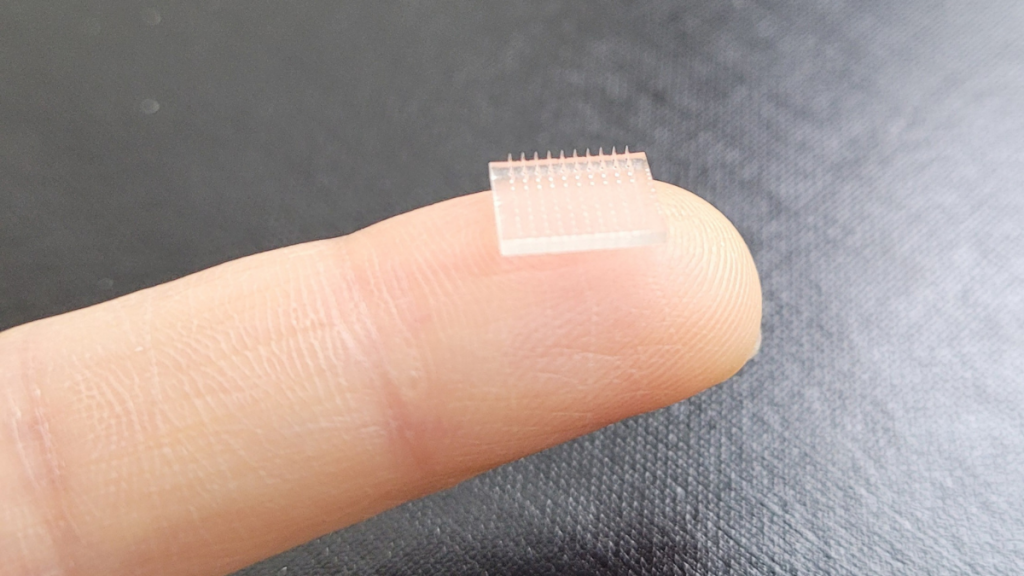
Featured picture presents A breathable mulberry paper patch combines 3D printed microneedles with wi-fi uric acid sensing for wearable well being care. Picture by way of Jeonbuk Nationwide College.