

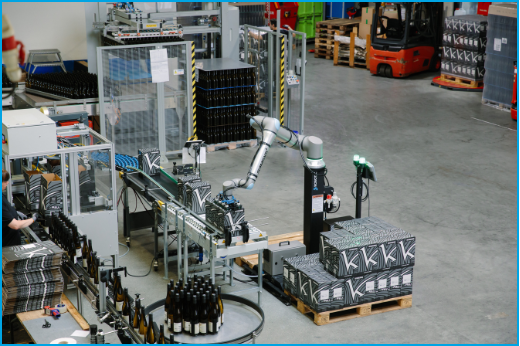

How three producers tackled seasonal peaks and minimize their reliance on momentary employees with palletizing automation.
Each fall, the identical query comes again on the plant flooring: what number of momentary employees do we have to get by means of the height?
For a lot of producers, the toughest job to fill is on the finish of the road. Palletizing is repetitive, bodily and the primary job new temp employees go away. Some begin on Monday and are passed by the following week. One espresso producer instructed us their COO needed to go all the way down to the ground himself to show a brand new pallet sample.
In our newest Automation Talks webinar, Beat the Vacation Rush: Automate Your Palletizing, Elisabeth St-Marie (Director, Demand Technology, Robotiq) and Tyler Johnson (Regional Gross sales Supervisor, Robotiq) shared what they realized from three producers who confronted seasonal peaks. One makes chocolate, one makes meals packaging, and one makes client items. The height does not must be the vacations. Garden merchandise in summer time and windshield washer fluid in winter create the identical strain.

Listed below are the 5 takeaways.
1. Begin with one simple software
A chocolate maker and its co-packer relied on about 300 momentary employees. Round Christmas, that quantity climbed to just about 500. Ten traces wanted palletizing.
They did not attempt to automate all ten. They began with two easy purposes: low payload, a measurable charge and simple to show. Robotiq generated configurations and simulations for 3 merchandise on the identical day they reached out. That gave their inner champion what they wanted to make the case. The client valued the simplicity and the brief lead time and selected Robotiq over a system they’d already ordered elsewhere.
The lesson: you needn’t automate every little thing directly. Decide one repetitive, labour-intensive end-of-line process, show it on one line, then broaden.
Undecided which line to start out with? Verify in case your software is a slot in 5 minutes.

2. Standardize it, then scale it
A food-packaging producer was operating seasonal peaks from August to the top of winter, generally seven days per week. They trusted contract staffing and when employees did not present up, they needed to cease traces. Every stopped line value 1000’s per day. Operators have been hand-stacking instances as much as 18 kg, throughout a whole bunch of SKUs.
They began with one PAL Workcell. As soon as it proved itself, they added 5 extra, then three extra: 9 palletizing Workcells in three phases. It labored as a result of the setup was commonplace. The primary set up takes about two days, together with coaching. Those after that may be prepared in at some point.
The lesson: a primary set up that is simple to repeat turns into your mannequin for different traces and different websites.
3. Decide automation that grows with you
A client items producer ran three shifts and a few third of its workforce was momentary. They needed to elevate manufacturing rapidly on older tools, in a good house, whereas planning a transfer to a brand new plant in a number of years.
A customized cell constructed round in the present day’s line would have turn out to be useless weight after the transfer. In order that they picked a cellular, low-footprint PAL configuration. It might deal with about 50 merchandise and is designed to develop from about 2 to as much as 10 instances per minute as demand rises. After they transfer, it strikes with them.
The lesson: remedy in the present day’s staffing drawback with out limiting tomorrow’s manufacturing.
4. Personal your resolution
You do not wish to name an outdoor engineering workforce on a Saturday night time shift as a result of a brand new SKU got here in. With PAL, educating a brand new SKU takes about two minutes and operators can handle the Workcell themselves. Once you’re operating dozens of SKUs in the course of the peak, that independence is what retains the road shifting.
5. Validate earlier than you commit
Automation does not scale when integration stays guide. That is why Robotiq constructed IQ. Begin with the Match Verify, a 5-minute questionnaire about your bins, charges and pallets. You get:
- An actual-time simulation of your Workcell and stack sample
- A one-page budgetary quote
- An ROI estimate based mostly in your operators, shifts and labour charge
From there, the Simulator permits you to add your flooring format to verify match and add security fencing, scanners and slip-sheet racks. There is not any upfront engineering dedication. And if you wish to see a cell operating, Robotiq’s 200+ licensed companions have palletizers on web site.
Is it too late for this 12 months?
It may not be. The palletizer itself might be prepared in a number of weeks. Conveyors, inner approvals and integration often resolve the actual timeline. That is the actual motive to start out early. If this 12 months’s peak is already right here, use it: depend your temp hires, time your end-of-line bottleneck and run a Match Verify. You may have the numbers for subsequent 12 months’s plan.
Need a reasonable timeline in your line? Discuss to a palletizing knowledgeable.

From the Q&A
- Security: PAL runs in collaborative mode by default. You’ll be able to add space scanners that sluggish or cease the robotic, gentle curtains, or full fencing. The proper stage will depend on your web site and native guidelines.
- Lacking merchandise: the system can examine case weight to about ±1 lb. That catches a lacking bottle in a 6-pack, not a lacking pouch in a field of 100.
- Labels: barcode and imaginative and prescient (OCR) checks have been added in previous initiatives, typically in pharma.
- Grippers: vacuum is commonplace, however customized grippers deal with open-top instances and facet picks.
Our suggestion
When you’re staffing up for the height yearly, begin along with your easiest, most painful SKU on one line. Then standardize and scale. If you have already got one palletizer operating, take a look at your subsequent line and use the identical setup.