

Deploying Mannequin Context Protocol (MCP) servers with AWS IoT Greengrass brings autonomous community diagnostics to the sting, the place connectivity failures occur and experience is difficult to seek out. Whether or not supporting large-scale army workouts, managing industrial infrastructure throughout distant areas, or working maritime and vitality networks, groups depend upon senior engineers to diagnose and resolve advanced community points. However this strategy has actual limits:
- Latency in response – Engineers should be bodily or remotely obtainable to troubleshoot, creating delays when connectivity is unreliable.
- Scalability limits – As machine fleets develop throughout distributed websites, guide diagnostics can’t preserve tempo.
- Data silos – Institutional data about machine conduct and failure patterns stays locked in particular person engineers reasonably than encoded in reusable programs.
- Inconsistent outcomes – With out standardized diagnostic workflows, troubleshooting high quality varies throughout groups and shifts.
When dozens of groups converge for a discipline train, every with competing priorities and tight timelines, the community turns into the one level of failure. The few individuals who can repair it develop into the bottleneck. The choice is to encode that experience into an edge agent that operates independently of connectivity, executing predefined diagnostic workflows at scale with out requiring an engineer to be current.
As a substitute of calling the professional, a crew member might provoke a diagnostic workflow by means of the domestically operating agent, which follows structured troubleshooting procedures to diagnose and advocate remediation steps.
That is the primary in a collection of weblog posts about Agentic AI on the Edge. On this publish, we cowl the why and supply an outline of the how. In future posts, we’ll dive deeper into deploying the answer utilizing AWS instruments, constructing the MCP server, and diagnostic workflows.
How an engineer troubleshoots as we speak
To know methods to construct an AI-powered diagnostic agent, it helps to first look at what a human professional does when troubleshooting a community situation:
| Step | What the Engineer Does | What They Use |
| Foundational data | Attracts on basic understanding of networking ideas – how ARP works, how DNS resolves, how BGP periods are established | Coaching and expertise |
| Area-specific experience | Follows a structured diagnostic strategy – a psychological or written runbook for the particular downside class | Runbooks, normal working procedures |
| System identification | Is aware of which programs to examine – the administration IP of the router, the place related metrics are collected, which interfaces to examine | Community documentation, asset inventories |
| Device execution | Makes use of particular instruments to assemble knowledge and take motion – SSH to entry a tool, REST APIs to question dashboards, SNMP to gather metrics | SSH, net terminals, dashboards, CLI instruments |
For instance, a runbook may say: “For those who see BGP session flapping, SSH into the router, examine the BGP neighbor desk, examine the maintain timer with the interface error counters, and confirm the upstream hyperlink standing.”
Mapping this workflow onto an AI agent is precisely what the Mannequin Context Protocol offers.
Mapping diagnostic workflows to Mannequin Context Protocol (MCP)
MCP is an open normal that gives a unified means for AI functions to connect with exterior knowledge sources, instruments, and companies. Fairly than constructing customized integrations for each software an AI agent wants to make use of, MCP defines a standardized interface between the agent’s orchestration layer and the capabilities it must entry.
MCP defines three core primitives:
- Instruments – Capabilities the AI agent can invoke to carry out actions (for instance, execute a ping, question SNMP OIDs, run CLI instructions in opposition to a router, name a REST API).
- Assets – Information sources the agent can learn for context (for instance, machine configuration information, community topology knowledge, monitoring dashboards).
- Prompts – Reusable immediate templates that encode professional workflows (for instance, a structured BGP troubleshooting process, a wi-fi connectivity diagnostic playbook).
Mapping the engineer’s workflow to MCP
The parallel between what a human professional does and what MCP offers is direct:
| Human Skilled | MCP + AI Agent Equal |
| Foundational data (networking, programs) | The small language mannequin (SLM) has foundational data. Ask it how ARP or DNS works, and it is aware of. Give it knowledge to interpret, and it may possibly. |
| Area-specific experience (runbooks, SOPs) | Prompts – expert-level context encoded as structured diagnostic workflows. These are the AI equal of runbooks. |
| System identification (IPs, endpoints, knowledge sources) | Assets – the programs the agent must troubleshoot straight or acquire knowledge from to diagnose points. |
| Device execution (SSH, REST, SNMP, CLI) | Instruments – the actions the agent invokes to execute diagnostic duties: SSH to entry a tool, REST to question APIs, SNMP to gather metrics. |
With this mapping, the inspiration is in place to construct agentic diagnostic programs that may scale, troubleshoot, and take corrective motion on behalf of operators, with out requiring a human professional for each situation.
On this publish, we present methods to package deal MCP servers as AWS IoT Greengrass parts to deploy autonomous, AI agent-driven community diagnostics on the edge. This sample encodes professional diagnostic data into reusable, deployable parts that function independently even when disconnected from the cloud.
The answer: MCP servers as Greengrass parts
AWS IoT Greengrass is an open supply edge runtime and cloud service that extends AWS capabilities to edge gadgets, supporting native processing, messaging, and knowledge caching with cloud synchronization. With this distributed computing framework, gadgets can function autonomously even when disconnected from the cloud.
By packaging an MCP server as a Greengrass part, we deliver this standardized AI-to-tool interface on to the community edge. The structure consists of three core components:
- MCP server part: A customized Greengrass part that exposes community diagnostic instruments (ping, traceroute, SNMP queries, CLI instructions) as structured MCP software definitions. The server runs domestically on the sting machine and communicates with community tools over the native community. The MCP server makes use of the stdio transport to speak with the agent part, protecting all diagnostic site visitors native to the machine.
- Edge ML part: A machine studying (ML) mannequin deployed by means of Greengrass that gives diagnostic evaluation capabilities, receives diagnostic requests, follows predefined determination bushes to pick acceptable MCP instruments, processes structured responses, and applies sample matching to establish potential root causes.
- Orchestration part: A light-weight agent constructed with Strands Brokers (an open supply SDK from AWS for constructing and orchestrating AI brokers) that coordinates the diagnostic workflow, manages dialog context, and persists outcomes domestically. Strands Brokers offers model-agnostic orchestration capabilities, so the agent can purpose about which instruments to name and in what sequence. The orchestration part communicates with the MCP server and SLM over Greengrass interprocess communication.
Structure overview
The next structure diagram exhibits the MCP server, SLM, and orchestration parts operating as Greengrass parts on an edge machine. The parts have native community entry to managed gadgets, with cloud synchronization by means of AWS IoT Core.
The structure spans AWS Cloud and an AWS IoT Greengrass edge machine.
On the sting, the S3FileDownloader part pulls mannequin information from Amazon Easy Storage Service (Amazon S3) and delivers them to the native inference engine for processing.
The MCP server executes diagnostic instruments (SSH, SNMP, REST) in opposition to native community gadgets.
The Strands Brokers part (Agent Edge) orchestrates the workflow, coordinating between the MCP server for software execution and the native inference engine for evaluation.
Within the cloud, AWS IoT Core synchronizes telemetry and outcomes between edge and cloud.
A cloud-based Agent with Amazon DynamoDB persists unresolved diagnostics, whereas an Amazon Elastic Compute Cloud (Amazon EC2) occasion hosts a cloud-side MCP server for escalation situations requiring extra compute.
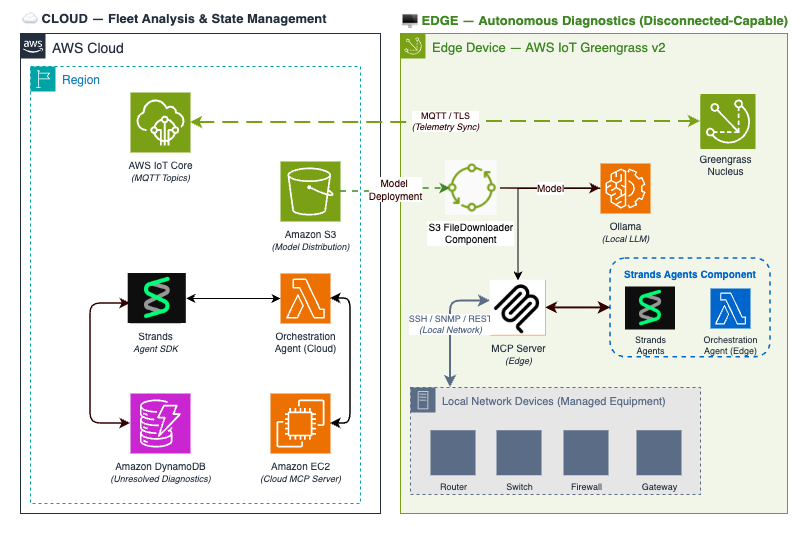
Determine 1: Structure
This determine exhibits the end-to-end structure. Strands Brokers operating on AWS IoT Greengrass carry out autonomous community diagnostics on the edge by utilizing a neighborhood massive language mannequin (LLM). The cloud layer handles fleet-wide evaluation, state administration, and mannequin deployment by means of Amazon S3.
Communication patterns
The diagnostic pipeline makes use of three Greengrass communication patterns:
- Interprocess communication (IPC): Part-to-component messaging inside the Greengrass nucleus lets the SLM, MCP server, and orchestration parts change structured knowledge with out exterior community dependencies. Greengrass IPC makes use of a native socket-based mechanism for low-latency messaging.
- Native MQTT: System-to-device communication on the edge facilitates diagnostic knowledge change with neighboring community tools and native monitoring programs.
- AWS IoT Core Matters: When connectivity is accessible, diagnostic outcomes, telemetry, and mannequin efficiency metrics synchronize to cloud companies for fleet-wide visibility.
Throughout disconnected intervals, the Greengrass stream supervisor and MQTT spooler briefly buffer diagnostic outcomes and telemetry domestically. Storage is certain by configurable dimension limits (default 256 MB per stream), with overflow insurance policies that discard the oldest knowledge when capability is reached. When connectivity is restored, the system robotically synchronizes this cached knowledge with cloud companies requiring no guide intervention.
How the diagnostic move works
When a diagnostic request is initiated, both by a scheduled set off, an alarm threshold, or a guide request, the next sequence executes fully on the edge:
- The orchestration part receives the diagnostic intent (for instance, “Examine why Website-A router is dropping BGP periods”).
- The sting machine studying (ML) part analyzes the request and determines an preliminary diagnostic plan.
- The ML part points structured software calls to the MCP server (for instance,
check_bgp_neighbors,get_interface_status,ping_gateway). - The MCP server executes the corresponding instructions in opposition to the goal community machine and returns structured outcomes.
- The ML part processes the outcomes, applies sample recognition algorithms, and evaluates predefined determination standards to find out whether or not extra diagnostic steps are wanted.
- The system logs the unresolved diagnostic session to an Amazon DynamoDB desk (together with context, steps tried, and confidence scores) and will be prolonged to set off an alert to the designated human operator.
- Outcomes are continued domestically and queued for cloud synchronization. They are often surfaced on the operator dashboard for real-time visibility, evaluated in opposition to severity thresholds for important findings, and aggregated into periodic readiness reviews. The human-in-the-loop retains closing authority over disposition selections. The system recommends, and the operator acts.
This diagnostic loop, the place the ML processes outcomes and executes the following diagnostic motion based mostly on predefined determination bushes, transforms static runbooks into adaptive troubleshooting workflows.
Conclusion
Packaging MCP servers as AWS IoT Greengrass parts brings standardized, AI agent-driven community diagnostics to the sting the place connectivity is unreliable and guide intervention is impractical.
As a substitute of pulling senior consultants off different important duties or ready for a distant callback, groups can now question a neighborhood diagnostic agent that causes by means of issues like an skilled engineer would.
By combining the MCP open normal with the modular part structure of AWS IoT Greengrass, you achieve autonomous diagnostic capabilities that:
- Function independently throughout disconnected intervals and synchronize robotically when connectivity returns.
- Encode diagnostic experience in reusable, deployable parts reasonably than counting on institutional data.
- Scale throughout distributed machine fleets with constant, standardized troubleshooting workflows.
- Adapt dynamically, the agentic loop delivers context-aware diagnostics that transcend static runbooks.
Whether or not you’re supporting tactical networks in protection, industrial infrastructure in manufacturing, or distant operations in vitality and maritime sectors, this structure offers a safe, extensible basis for edge AI that adapts as community complexity grows.
To get began or study extra:
In regards to the authors