


Automating Web of Issues (IoT) firmware replace orchestration with an AI agent helps fleet operators deploy updates confidently at scale. Firmware updates require cautious sequencing: the suitable units first, on the proper time, with steady well being monitoring and speedy rollback when wanted. Right this moment, operations groups manually plan deployment waves, monitor success charges, and make rollback choices. As fleet dimension grows, the handbook method turns into a bottleneck.
On this publish, we present you easy methods to construct an AI agent that autonomously orchestrates firmware deployments throughout your IoT fleet. The agent selects deployment waves based mostly on gadget threat profiles and schedules round manufacturing home windows. It displays rollout well being in actual time and triggers automated rollback when failure charges exceed thresholds.
The problem: Firmware deployments at fleet scale
Firmware updates to IoT fleets contain choices that develop extra complicated as your fleet scales:
- Wave planning: Deciding which units go first requires context. Greatest follow is to begin with low-risk units (improvement, non-production), then canary teams (small manufacturing subset), then full rollout. What counts as low-risk relies on gadget kind, location, manufacturing schedule, and criticality.
- Timing: Updates that restart units shouldn’t occur throughout peak manufacturing. Every facility has completely different schedules, time zones, and upkeep home windows.
- Well being monitoring: After every wave, it’s good to confirm units come again on-line, report right firmware model, and proceed working usually. For illustrative functions, think about a fleet of 5,000 units. A 2 p.c failure price in a canary group of fifty is one gadget, however a 2 p.c failure price fleet-wide is 100 bricked units.
- Rollback choices: The edge for stopping and rolling again relies on the failure mode: a connectivity-lost failure is perhaps transient (wait), however a boot-loop failure is everlasting (rollback instantly). An AI agent provides failure-type reasoning on prime of the percentage-based cancellation that AWS IoT Jobs gives natively.
An AI agent makes these choices dynamically based mostly on real-time fleet state slightly than static guidelines.
Answer overview
The answer makes use of an AI agent because the decision-maker and AWS IoT Jobs for the precise firmware supply. The agent plans deployment waves, displays well being after every wave, and decides whether or not to proceed, pause, or roll again. AWS Step Features orchestrates the end-to-end workflow, and Amazon DynamoDB shops the fleet stock and deployment historical past.
Structure
The next diagram exhibits the AI-driven firmware replace orchestration structure. The workflow strikes by way of three phases: deployment planning (steps 1–3), wave execution (steps 4–6), and well being evaluation with conditional rollback (steps 7–9).
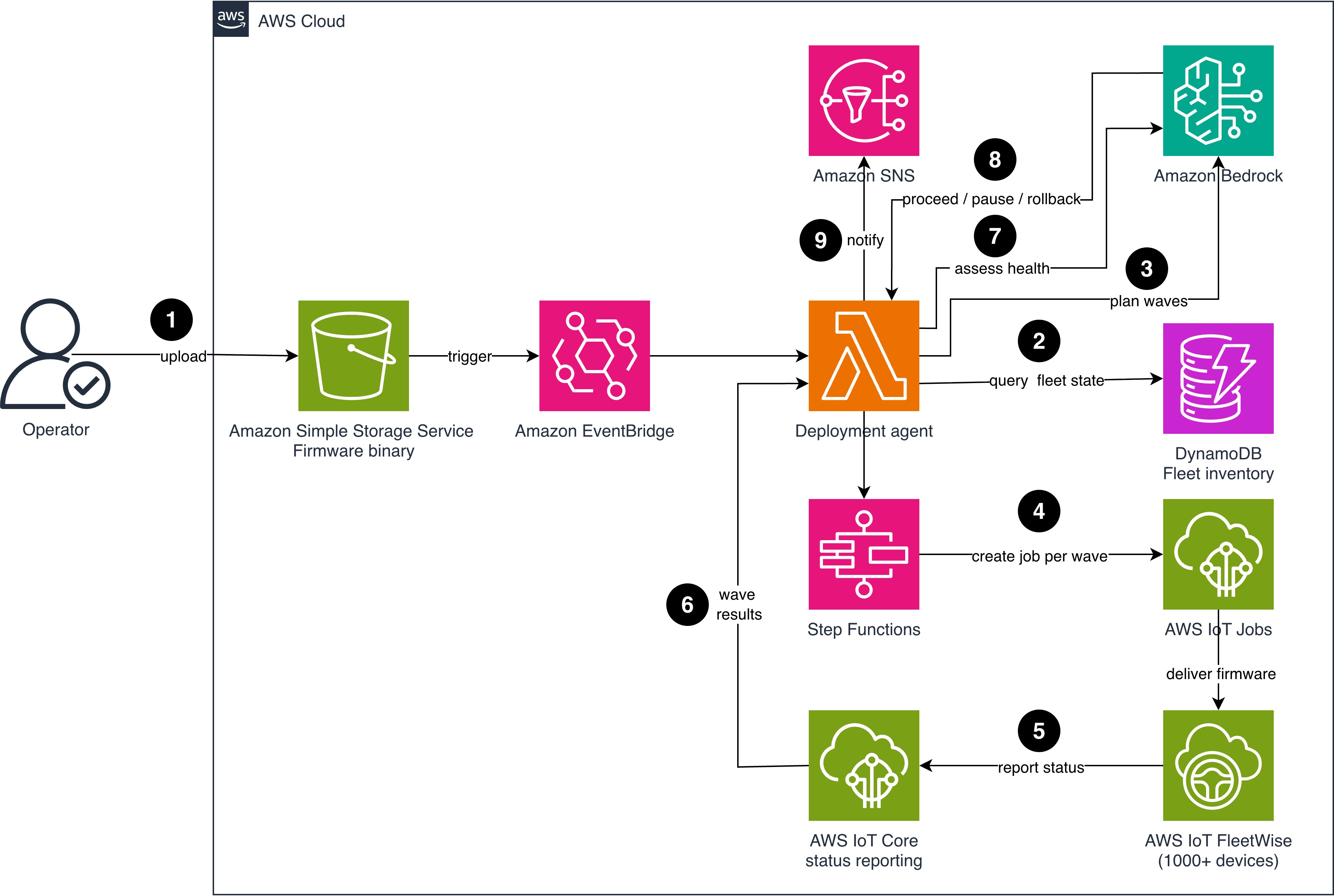
Determine 1: AI-driven firmware replace orchestration structure on AWS
Deployment planning
The next steps describe how the agent plans deployment waves based mostly on the fleet profile.
- An operator uploads a brand new firmware binary to Amazon Easy Storage Service (Amazon S3) and triggers the agent by way of Amazon EventBridge with goal standards (gadget kind, minimal model, goal model).
- The agent queries Amazon DynamoDB for the fleet stock. For every gadget, it retrieves kind, location, firmware model, criticality, final replace end result, and manufacturing schedule. For the DynamoDB desk schema and entry patterns, see the stacks/firmware_agent_stack.py file within the pattern code repository.
- The agent makes use of Amazon Bedrock to plan deployment waves based mostly on the fleet profile. The ensuing plan features a canary wave (5 p.c of low-risk units), an early adopter wave (20 p.c blended), and full rollout waves (remaining 75 p.c in batches of 500). Earlier than together with a tool in a wave, the agent evaluates the gadget’s manufacturing schedule. Every gadget defines lively hours by facility and time zone. If a tool is presently inside its manufacturing window, the agent excludes it from the present wave and defers it to a later batch. This prevents firmware restarts from disrupting lively manufacturing processes.
Manufacturing window scheduling
Earlier than together with a tool in any wave, the agent evaluates the gadget’s manufacturing schedule utilizing the get_device_risk_profile instrument. Every gadget report in DynamoDB incorporates a production_schedule subject with start_hour, end_hour, and timezone values. The agent converts the present time to the gadget’s native timezone and checks whether or not it falls inside the lively window.
If a tool is presently inside its manufacturing window, the agent excludes it from the present wave and defers it to a later batch. For in a single day schedules that span midnight (for instance, start_hour: 22, end_hour: 6), the agent handles the wraparound accurately. This prevents firmware restarts from disrupting lively manufacturing processes.
You possibly can observe this habits within the Step Features execution historical past. When the agent plans waves, units in lively manufacturing home windows don’t seem within the wave’s thing_names listing. The get_device_risk_profile instrument returns an is_in_production_window boolean for every gadget, which the agent makes use of throughout wave composition.
Wave execution
- AWS Step Features executes the deployment plan. For every wave, it creates an AWS IoT job focusing on the chosen units with the firmware from Amazon S3.
- AWS IoT Jobs delivers the firmware to every gadget, managing the obtain, verification, and set up lifecycle. Gadgets report standing again to AWS IoT Core as certainly one of: queued, in-progress, succeeded, failed, rejected, or timed-out.
- Step Features waits for the wave to finish (units report last standing) or instances out after a configurable window (default: half-hour per wave).
Well being evaluation
- After every wave completes, the deployment agent queries AWS IoT Core for gadget shadows and telemetry to evaluate fleet well being: success depend, failure depend, and failure varieties (connectivity-lost, boot-loop, version-mismatch).
- The agent makes use of Amazon Bedrock to motive over the well being knowledge and determine: proceed to subsequent wave, pause for investigation, or rollback the present wave.
Rollback
- When the agent decides to roll again, it invokes the
rollback_waveinstrument. This instrument cancels the in-progress AWS IoT job and creates a brand new job, focusing on solely the failed units with the earlier firmware model. Gadgets that efficiently up to date stay on the brand new firmware. The agent notifies the operator by way of Amazon Easy Notification Service (Amazon SNS) with a proof of the failure mode, affected gadget depend, and the firmware model restored. No subsequent waves execute after a rollback.
Step-by-step deployment
On this tutorial, you deploy the firmware orchestration agent and check it with a simulated fleet of 100 units.
Conditions
Confirm that you’ve got the next:
- An AWS account with AWS Cloud Growth Package (AWS CDK) bootstrapped.
- Python 3.13 or later.
- AWS credentials configured.
- Amazon Bedrock entry with AWS Identification and Entry Administration (IAM) permissions to invoke Anthropic Claude Haiku 4.5 (or your most popular basis mannequin).
- An IoT fleet registered on AWS IoT Core (or use the included simulator).
The sample-iot-firmware-orchestration-agent incorporates the whole implementation, together with the CDK stack, agent instruments, Step Features workflow, and fleet simulator scripts. Clone the repository to get began:
To deploy the infrastructure
The AWS CDK stack deploys the core orchestration parts: AWS Step Features state machine, deployment agent AWS Lambda perform, and Amazon DynamoDB tables (fleet stock and deployment historical past). It additionally provisions the supporting infrastructure: Amazon S3 bucket for firmware binaries, Amazon SNS matter for notifications, and Amazon EventBridge set off.
Confirm the stack deployed efficiently by checking the AWS CloudFormation console for the FirmwareAgentStack in CREATE_COMPLETE standing.
Deployment agent configuration
The deployment agent makes use of the Strands Brokers SDK (pip set up strands-agents), an open supply Python framework for constructing AI brokers that integrates with Amazon Bedrock. Amazon Bedrock gives entry to basis fashions (FMs) from a number of suppliers. This answer makes use of Anthropic Claude Haiku 4.5 for its quick inference velocity and value effectivity for agentic workloads. The agent invokes the mannequin by way of Amazon Bedrock with the fleet stock as context, so it could possibly motive about gadget threat profiles and generate an optimum wave plan.
The next desk describes the 5 instruments the agent exposes to Amazon Bedrock:
| Software | Objective |
get_fleet_inventory |
Question DynamoDB for units eligible for replace (by kind, model) |
get_device_risk_profile |
Retrieve criticality, manufacturing schedule, and replace historical past per gadget |
get_wave_health |
Get success/failure/timeout counts from a operating AWS IoT job |
create_deployment_wave |
Create an AWS IoT job focusing on a selected set of units |
rollback_wave |
Cancel the present job and redeploy earlier firmware to failed units |
The get_device_risk_profile instrument retrieves gadget metadata from the fleet stock: criticality degree, {hardware} revision, manufacturing schedule, and final replace end result. Within the pattern, these attributes are populated by the fleet simulator script. In a manufacturing setting, you’d populate these fields out of your present asset administration, serialization, and install-tracking methods. The criticality designation determines wave ordering: LOW-criticality units go into the canary wave first, accepting the very best threat of failure on units the place the operational impression is lowest.
This pattern makes use of express gadget enumeration (SNAPSHOT focusing on) when creating AWS IoT jobs. In follow, firmware-over-the-air (FOTA) jobs at scale use static and dynamic Factor Teams to outline replace targets. Dynamic Factor Teams robotically embrace units matching a question (for instance, all units with firmware_version < 1.2.0 and device_type = sensor-v2). This handles units that come on-line mid-rollout. For extra details about Factor Group focusing on patterns, consult with Design IoT Jobs for speedy large-scale gadget updates with superior gadget group goal patterns and Utilizing dynamic factor teams to constantly replace software program on units.
The agent’s system immediate encodes the wave planning guidelines: canary at 5 p.c, early adopter at 20 p.c, then full rollout. It additionally encodes well being evaluation thresholds: proceed above 98 p.c, pause at 95–98 p.c, and rollback beneath 95 p.c or on boot-loop detection.
The agent is configured in lambda/deployment_agent/agent.py. It makes use of the Strands Brokers SDK BedrockModel class to invoke Anthropic Claude Haiku 4.5 (mannequin ID: us.anthropic.claude-haiku-4-5-20251001-v1:0) by way of the Amazon Bedrock ConverseStream API. The Agent class registers the 5 instruments beforehand listed and passes the system immediate containing the wave planning guidelines and resolution thresholds.
To check with simulated fleet
The repository features a fleet simulator that registers digital units and simulates replace outcomes:
The next instance exhibits the anticipated habits for the canary_failure situation:
- Agent plans three waves: canary (5 units), early adopter (20 units), full (75 units).
- Wave 1 (canary) executes: 4 succeed, 1 fails with boot-loop.
- Agent assesses: 1/5 = 20 p.c failure price, and boot-loop detected.
- Agent resolution: ROLLBACK – “Boot-loop failure detected in canary wave. 20 p.c failure price exceeds 5 p.c threshold. Rolling again affected gadget and halting deployment. Firmware might need a compatibility difficulty with gadget {hardware} revision.”
- Agent rolls again the failed gadget, cancels remaining waves, sends Amazon Easy Notification Service (Amazon SNS) notification to operator.
The partial_connectivity_loss situation demonstrates threshold-triggered rollback distinct from boot-loop detection. On this situation, connectivity failures in a single facility produce a hit price between 95–98 p.c. The agent pauses and retries as much as 3 times. If the success price doesn’t enhance after three consecutive pauses, the agent escalates to rollback based mostly purely on the edge rule slightly than a selected failure kind.
Monitoring wave well being
After triggering a deployment, you may monitor the agent’s well being evaluation in actual time by way of the AWS Step Features console. Every execution exhibits the wave-by-wave development with the agent’s resolution at every checkpoint.
The next JSON exhibits the abstract that the get_wave_health instrument returns after every wave completes:
The agent makes use of this knowledge together with the choice framework to find out the subsequent motion. You possibly can view the total reasoning chain within the Step Features execution historical past. This consists of the agent’s pure language clarification for every resolution it makes at each wave checkpoint.
Deployment resolution flowchart
The agent applies the next resolution logic after every wave completes: if the success price exceeds 98 p.c and no boot-loop failures exist, it proceeds. If any boot-loop failure is detected, it rolls again instantly no matter different metrics. If the success price falls between 95–98 p.c with solely connectivity-lost failures, it pauses and retries after 10 minutes. Combined failure varieties within the 95–98 p.c vary set off a rollback. Success charges beneath 95 p.c set off a right away rollback.
The agent encodes this logic in its system immediate however can motive past it for novel conditions. For instance, if all failures share the identical {hardware} revision, the agent pauses to research a compatibility difficulty slightly than performing a blanket rollback.
The next diagram exhibits the agent’s resolution logic after every wave completes:
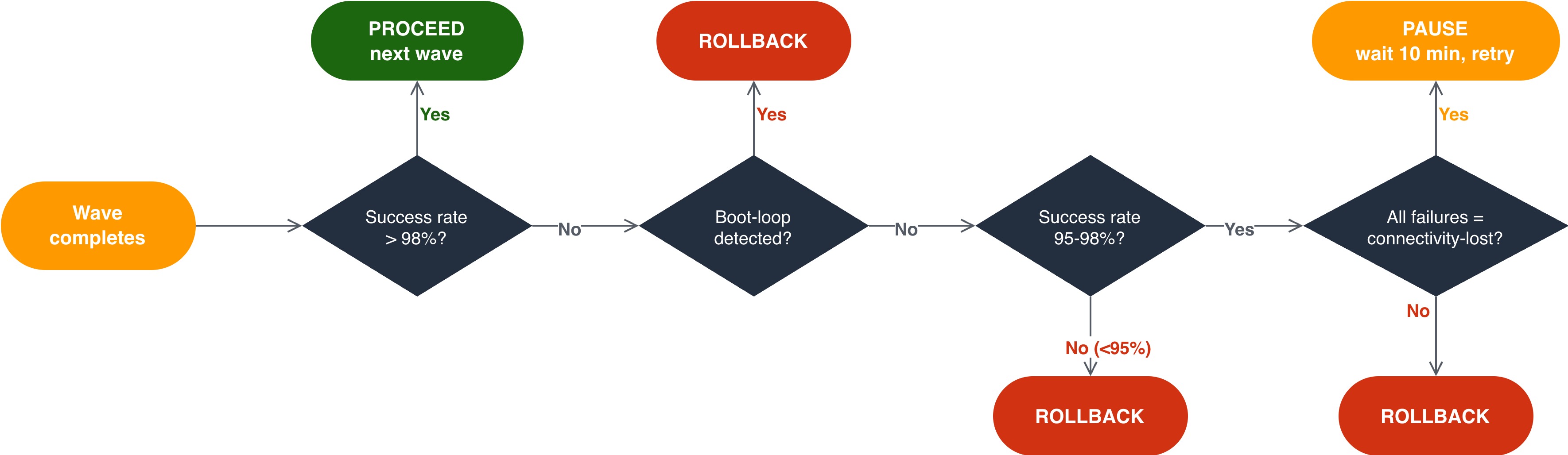
Determine 2: Deployment resolution flowchart
How this differs from AWS IoT Jobs built-in cancellation configuration
AWS IoT Jobs gives a local cancellation configuration that cancels a job when a failure share threshold is exceeded. The AI agent extends this basis with contextual reasoning:
| Functionality | AWS IoT Jobs cancellation configuration | AI orchestration agent |
| Set off situation | Static share threshold (for instance, >10% failed) | Causes over failure TYPES (boot-loop, connectivity-lost, timeout) |
| Context consciousness | Similar threshold for all units in a job | Considers gadget criticality, manufacturing schedule, historic success price |
| Wave planning | Charge-based rollout with configurable price limits | Plans canary, then early adopter, then full rollout based mostly on threat profiles |
| Novel conditions | Proportion-based move/fail analysis | Causes over patterns (for instance, “all failures are identical {hardware} revision, examine compatibility”) |
| Motion choices | Cancel solely | Proceed, pause and examine, rollback particular units, retry transient failures |
| Scheduling | Time-window scheduling solely | Avoids manufacturing peaks, coordinates throughout services and time zones |
AWS IoT Jobs handles firmware supply because the execution layer. On prime of this, the agent provides a choice layer, continuing, pausing, or rolling again based mostly on semantic reasoning slightly than static counts. They’re complementary: the agent creates and manages AWS IoT Jobs slightly than changing them.
Accountable AI issues
With this answer, you deploy an agentic system that autonomously decides whether or not to advance, maintain, or revert firmware deployments. The next guardrails help accountable operation:
- Encoded thresholds: The agent’s system immediate incorporates express resolution thresholds (proceed above 98 p.c, rollback beneath 95 p.c) and a restricted instrument allowlist (solely 5 instruments). The agent can’t create, delete, or modify units. Wave sizes are capped at 500 units most.
- Human oversight: For manufacturing fleets, we suggest including human approval gates earlier than full-rollout waves. The canary and early-adopter waves validate robotically, however a human operator can overview the agent’s reasoning earlier than approving deployment to the total fleet.
- Audit path: Each agent resolution, together with the pure language reasoning chain, is logged within the AWS Step Features execution historical past. Operators can overview why the agent determined to advance, maintain, or revert at every checkpoint. Structured JSON logs in Amazon CloudWatch present deployment_id and wave_number correlation for end-to-end tracing.
Safety issues
When deploying firmware to IoT units, implement the next safety controls:
- Firmware signing: Signal firmware binaries with Code Signing for AWS IoT earlier than importing to S3. Gadgets confirm the signature earlier than making use of the replace, stopping tampered binaries from being put in.
- Encryption: Allow server-side encryption with AWS Key Administration Service (SSE-KMS) encryption on the Amazon S3 bucket storing firmware binaries. Implement HTTPS-only entry by way of a bucket coverage. AWS IoT Jobs delivers firmware URLs over Transport Layer Safety (TLS).
- AWS Identification and Entry Administration (IAM) least privilege: The deployment agent Lambda position wants solely
iot:CreateJob,iot:DescribeJob,iot:CancelJob,dynamodb:Question,dynamodb:GetItem, andbedrock:InvokeModel. It doesn’t wantiot:DeleteThing,iot:UpdateCertificate, or administrative permissions. - System authentication: Gadgets authenticate to AWS IoT Core utilizing X.509 certificates provisioned throughout manufacturing. Authenticated units can obtain job paperwork and obtain firmware from the presigned S3 URL.
Value issues
The AI orchestration layer provides minimal price on prime of the usual AWS IoT Jobs deployment. For a fleet of 1,000 units deployed in three waves (canary, early adopter, full rollout), the agent reasoning price is roughly $0.02. Amazon Bedrock costs apply per agent resolution level (one per wave), not per gadget. AWS IoT Jobs has no per-execution cost. Commonplace AWS IoT Core messaging charges apply for gadget standing updates.
For bigger fleets of over 5,000 units with 5 waves, the overall orchestration overhead stays roughly below $0.05 per deployment. The associated fee scales with the variety of wave choices, not fleet dimension.
Clear up
To keep away from ongoing costs, delete the deployed assets:
Conclusion
On this publish, you realized easy methods to construct an AI agent that plans deployment waves, evaluates manufacturing schedules to keep away from disruptions, and displays rollout well being. The agent makes autonomous choices to advance, maintain, or revert based mostly on failure-type evaluation. The agent begins with a conservative 5 p.c canary and scales up solely when the info helps it. As a result of the agent evaluates well being knowledge programmatically as quickly as a wave completes, deployment choices occur with out ready for handbook overview cycles.
The check situations on this publish train 100 simulated units. For bigger manufacturing fleets, the structure scales horizontally. AWS IoT Jobs handles supply at fleet scale, and the agent’s reasoning price applies to every wave slightly than every gadget.
You possibly can apply this sample to different phased fleet-wide operations, resembling configuration modifications, certificates rotation, and have flag rollouts. It is a reference implementation. Earlier than deploying to manufacturing, conduct an intensive safety overview. Implement extra controls resembling human approval gates earlier than full-rollout waves. Take a look at extensively in non-production environments.
Clone the sample-iot-firmware-orchestration-agent and configure the wave guidelines and well being thresholds in your fleet.
References
In regards to the authors