



You’re two hours into the Design module on the CCIE Collaboration lab. A buyer temporary sits in entrance of you: a 40-site enterprise, a few PSTN contracts that may’t be damaged, a board that wishes survivability on the prime shops.
Under it, 4 design choices. Right here’s the uncomfortable half: three of them would technically work. Just one is correct for this buyer.
There’s no system to log in to, no present command to substantiate you guessed accurately, and the reply isn’t written down anyplace. Both you purpose your technique to it, otherwise you don’t.
Right here’s why the Design module journeys good engineers. Not as a result of it’s unfair, however as a result of it assessments a special muscle than the remainder of the examination. Deploy rewards recall and pace, however the Design module rewards judgment: justifying why one structure beats one other, throughout all seven blueprint domains, underneath the clock. Most candidates over-prepare what they’ll lab and under-prepare what they’ll’t.
The excellent news, and the explanation for this submit: Design is learnable. Not by memorizing extra SRND guides, however by finding out the resolution as a substitute of the subject. That is the tactic we educate—the identical one a TAC engineer used to go the CCIE Collaboration v3.1 Sensible Examination from scratch, and the identical one you possibly can apply to each line of the CCIE Collaboration Sensible Examination blueprint.
What ‘Design-grade’ really means
A Design reply isn’t simply the setting.
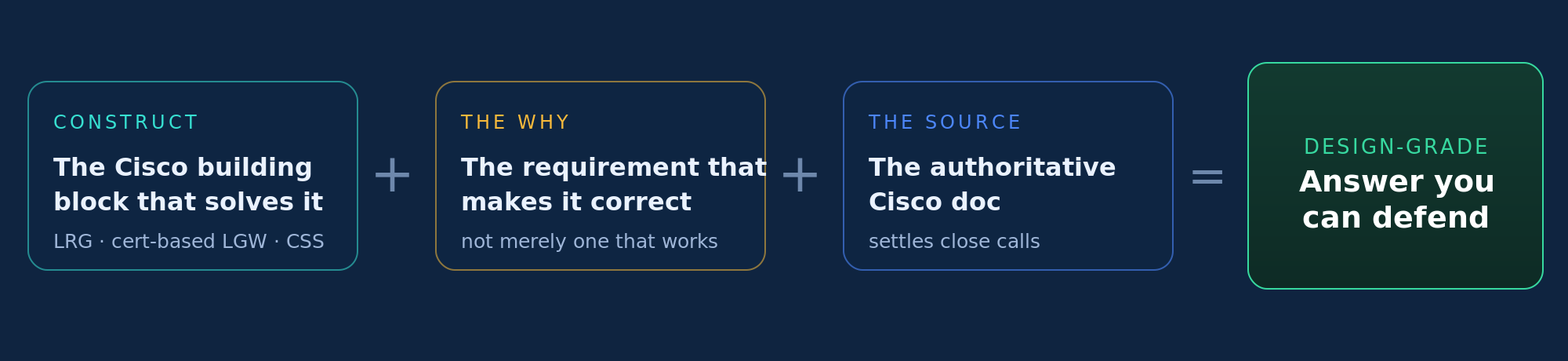
Get this framing proper, and the remaining follows. A Design-grade reply is three issues directly—the assemble, plus the why, plus the supply.
Determine 1. Produce all three for a subject and also you personal it at examination degree. Solely the assemble? You understand the product, not the design—and that hole is precisely what the module hunts for.
The approach that breaks ties
Discover the differentiator constraint.
While you’re down to 2 choices that each look legitimate, cease evaluating the choices and return to the temporary.
Someplace within the buyer’s paperwork—an electronic mail snippet, a topology observe, one line of enterprise context—is a key phrase that decides it. OPEX discount. Finish-to-end encryption. Minimal person disruption. No on-prem belongings. That phrase is the tie-breaker, and it renders one among your two “appropriate” choices flawed.
Determine 2. The elimination technique. Learn the temporary first and write the details down earlier than you have a look at a single choice — then eradicate towards the temporary, not towards the docs.
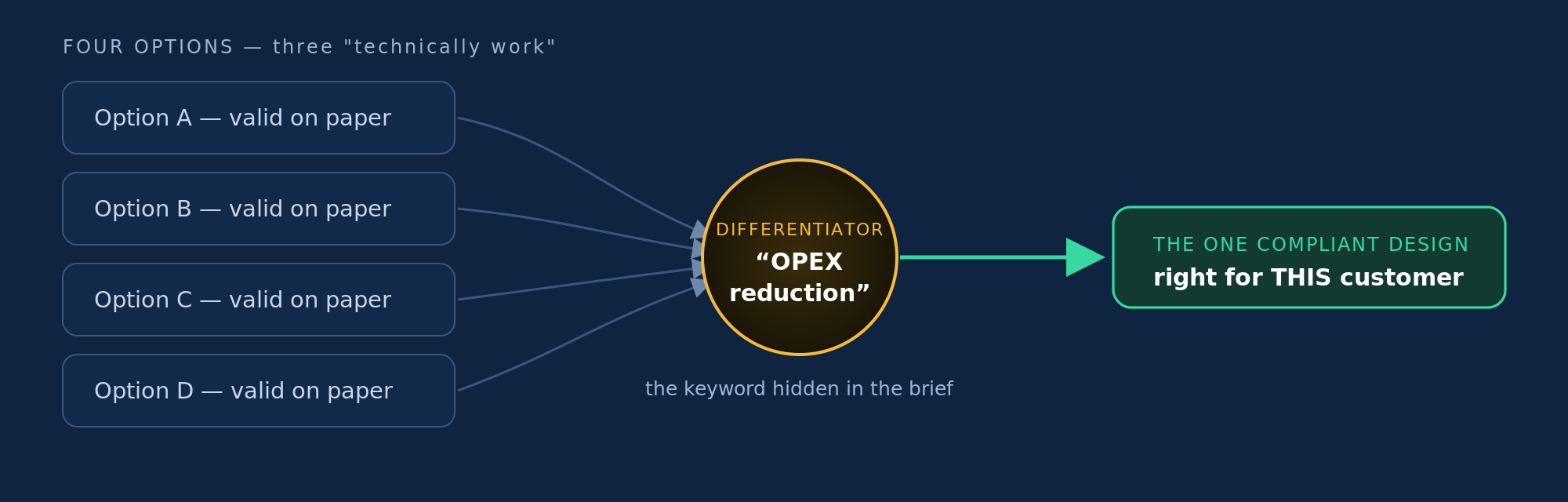
The road to recollect: “Supported within the documentation” just isn’t the identical as “proper for this buyer.” The temporary decides.
Decode-to-Design Pipeline
Decode examination subjects → Design-grade gadgets.
One pipeline. Run each blueprint matter by it.
Right here’s the engine. Take any subtask on the blueprint and push it by the identical six phases each time. It converts a dry matter line into follow that appears and feels just like the examination — and teaches you to generate that follow for your self.
Determine 3. The Decode-to-Design pipeline. Run it throughout the blueprint, and also you construct a private financial institution of design-grade gadgets and internalize the decoding behavior the module really rewards.
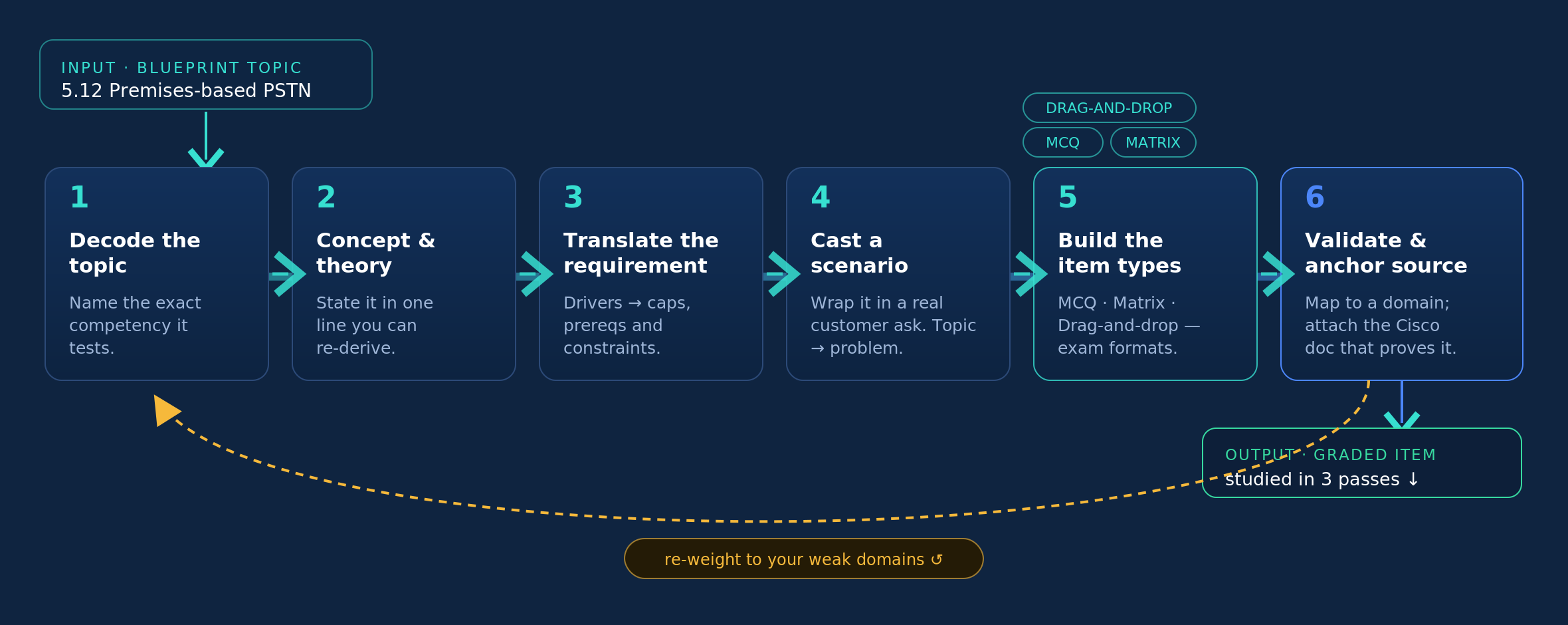
Run it throughout each area, and also you get a complete financial institution.
That’s precisely what we did. Fifteen design gadgets (D1–D15) cowl all seven blueprint domains—60 state of affairs questions, 6 matrix gadgets, 4 drag-and-drops, each reply source-anchored—and the entire thing is printed as an open repo you possibly can clone, drill, and prolong.
Determine 4. The financial institution, mapped to the blueprint. Bars are area weights — discover Name Management and Edge Providers are 20% every, so the merchandise combine leans there, similar to the examination.
Every merchandise carries all three examination codecs (the identical three merchandise varieties the Design module makes use of):
- A number of-choice questions (choose all that apply)
- Matrix (e.g., registration vs certificates Native Gateway throughout capability, auth, and NAT)
- Drag-and-drop (order the 9 UCM objects for the Webex interconnect, or place the hybrid PSTN topology)
One matter, decoded finish to finish
Watch it run on a single blueprint line.
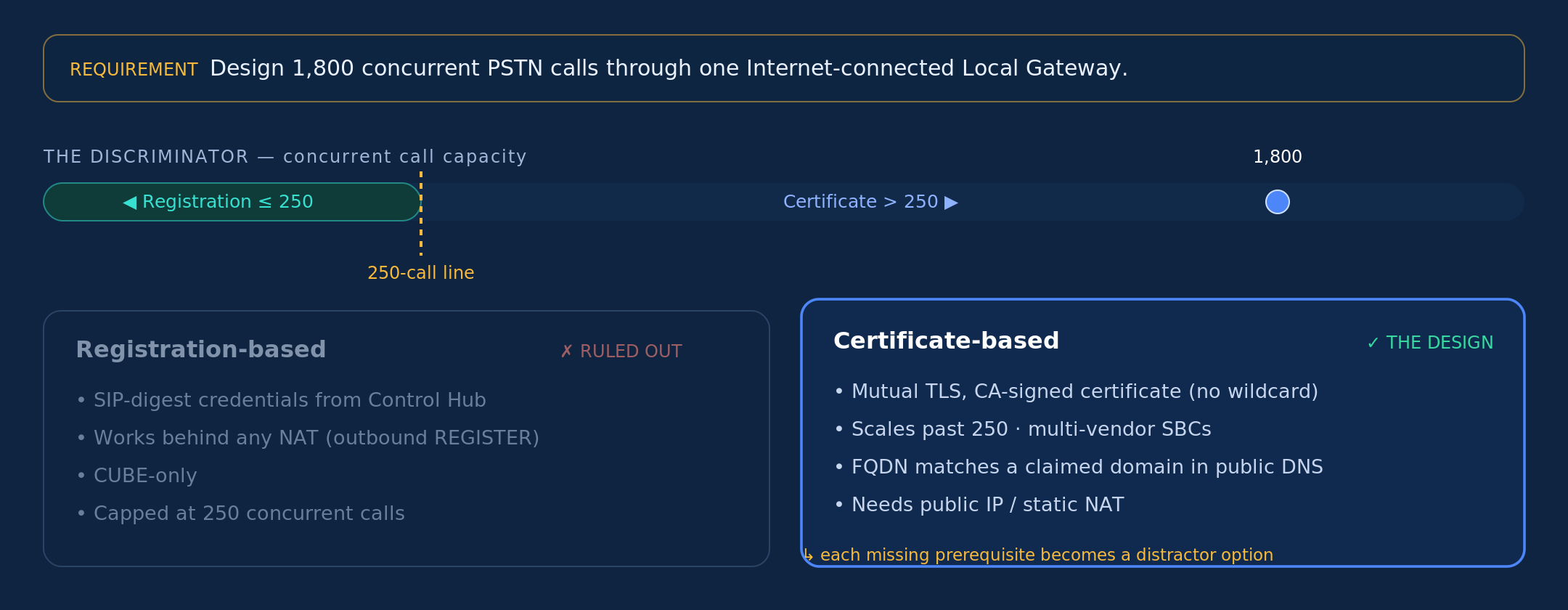
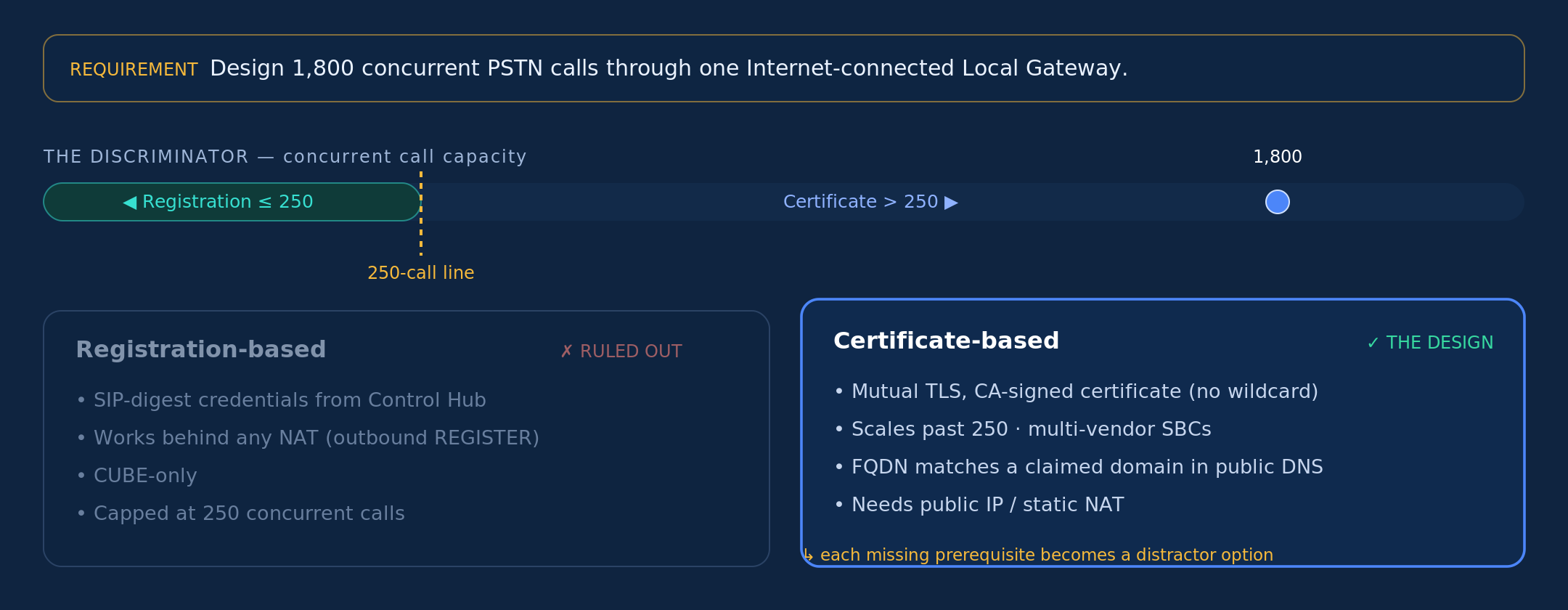
Take matter 5.12 – Premises-based PSTN by way of Native Gateway. An LGW authenticates to the Webex cloud one among two methods, and the entire design hinges on a single quantity: 250 concurrent calls.
Determine 5. 1,800 > 250 → certificate-based, full cease. The conditions it drags in (declare the area, publish the FQDN, purchase the cert, static NAT) are the precise traps the Design merchandise vegetation as distractors.
Now discover the way you’d research the completed merchandise—in three passes. Learn the idea, then the labored instance, then the examination angle. Then shut the web page and re-derive the design rule from reminiscence earlier than you progress on. (Most individuals skip that final step, however it’s the one which makes it stick.)
A takeaway you need to use at present
Requirement → Design reply.
Design pace comes from turning recognizable requirement phrases into immediate reflexes. Listed here are a couple of from the Webex Calling PSTN household, to point out the form of it:
| When the temporary says… | The design reply is… |
|---|---|
| No on-prem belongings, nation is roofed | Cisco Calling Plan |
| Preserve our service contracts, no SBC | Cloud Related PSTN |
| Connect with an present on-prem UCM | Native Gateway—the one choice that may deal with 1,800 concurrent calls by one LGW; certificate-based trunk (> 250) |
| All UCM options, within the cloud | Devoted Occasion |
Construct your individual model of this desk for each area as you decode it. By examination day, half your work is pattern-recognition, and also you’ve reserved your pondering time for the genuinely shut calls.
Proof it’s satisfactory
You don’t must design for a residing to go this.
Among the strongest latest passes come from engineers with slim backgrounds—TAC break/repair specialists, software admins—who had by no means routed a name or drawn an structure earlier than they began. The up to date v3.1 lab, with its Webex Calling integration, could be very satisfactory in months of centered prep, not years.
The trail that works is constant: begin broad (CLCOR takes you from a single product to the entire portfolio—name routing on CUCM and CUBE, dial plans, QoS), lean on the official CCIE Collaboration preparation information, drill deploying from scratch till end-to-end calling is second nature, and solely then pay for timed follow reps.
For Design particularly, do precisely what this technique describes—learn the temporary, write the details down earlier than touching the choices, and eradicate per website. It is extremely satisfactory. Sit it sooner moderately than later — the blueprint solely grows from right here.
Your design prep package
You have already got most of what you want, and practically all of it’s free:
- CCIE Collaboration Preparation Information (Cisco Studying Community)—the spine. Begin right here.
- CCIE Follow Labs: Rentable pods mirroring the true examination units, software program, and topology. For timing and polish as soon as you possibly can already construct end-to-end—not for studying the fundamentals. Reserve a 4-hour timeslot
- dCloud: Migrating to Webex Calling: A free, public lab strolling by a full migration (onboarding, licensing, dial plan, native gateway). The very best hands-on for the Webex Calling aspect.
- Construct your individual: A couple of VMs in ESXi on the same topology get you a lot of the method for free of charge. Rehearse deploying from scratch—the muscle break/repair work by no means builds.
- Webex Calling configuration workflow & assist.webex.com: Reachable in the course of the examination’s DOO module, with the Management Hub AI assistant. Follow utilizing them so that they’re quick on the day.
- CollabForge: The merchandise financial institution behind this submit: 15 design gadgets throughout all seven domains, 60 self-test questions, 6 matrix + 4 drag-and-drop gadgets, every source-anchored, plus a runnable CLI (collabforge quiz –area 5). Clone it and drill at present, add your individual gadgets from the template, or hand a blueprint line to an AI agent and generate a brand new one. The strategy on this submit, was one thing you possibly can run.
Why you must ebook the lab now
The examination validates the hybrid, cloud-and-on-prem calling abilities actual deployments want at present, and the blueprint solely will get broader from right here—extra Webex, extra cloud, and an AI-augmented roadmap. Each revision provides floor space.
The examination is essentially the most acquainted it should ever be to you proper now.
Assume like an architect put together for fulfillment on the Design module
It isn’t a reminiscence take a look at, and it isn’t luck. It’s a technique. Decode a subject, state the idea, translate the requirement, forged the state of affairs, construct the merchandise, anchor the supply.
Do this throughout the blueprint and also you’ll stroll into Module 1 doing what the module is definitely testing: pondering just like the architect the client employed.