


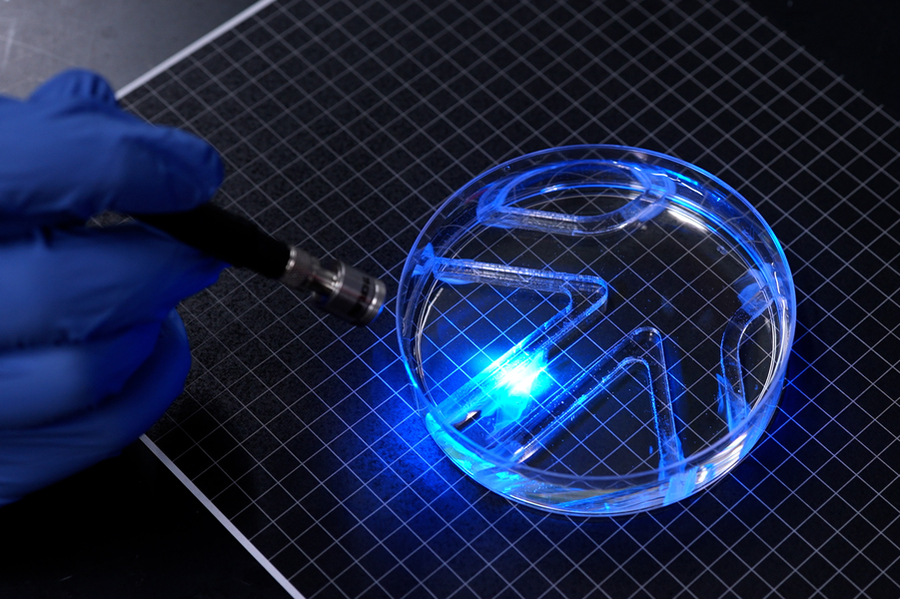
 MIT engineers developed a delicate robotic that may flap by means of water in response to flashes of sunshine. Picture credit score: Melanie Gonick, MIT.
By Jennifer Chu
Swimming can take lots of muscle. However as MIT engineers have discovered, even a single layer of muscle cells can energy by means of water if designed proper.
In a paper showing in the present day within the journal Superior Practical Supplies, the crew presents a design for a skinny, muscle-powered swimming robotic. The “skeleton” of the aquabot is produced from a movie of gel that’s in regards to the size and width of a stick of gum. The 2 halves of the gel kind the “fins” of the bot. Every fin is roofed with a layer of stay muscle cells that’s a lot thinner than a single strand of hair. The cells are genetically engineered to twitch in response to gentle.
When the researchers shine gentle on one fin, the muscle mass on its floor twitch in response, inflicting the entire fin to flap with sufficient power to drag the robotic by means of water. By flashing gentle on one fin or the opposite, at varied intervals, they’ll management the swimming robotic’s route and pace.
The engineers confirmed that the paper-thin bot may swim and swivel by means of a easy watery maze. At its quickest, the robotic can swim a distance of about 4 instances its physique size in a single minute. That’s a snail’s tempo in comparison with Olympic swimmers, who can cowl as much as 65 physique lengths per minute. However the bot may maintain its personal towards extra leisurely swimmers just like the cow shark, which explores the ocean at about the identical charge.
 Of their new work, the crew Raman Lab aimed to maximise muscle actions to supply extra power — sufficient, say, to energy a swimming robotic. Pictured is Maheera Bawa, a graduate scholar at Raman Lab. Picture credit score: Melanie Gonick, MIT.
“It takes lots of power to maneuver by means of water versus air,” says examine writer Ritu Raman, affiliate professor of mechanical engineering at MIT. “The robotic’s fairly sturdy, given its measurement.”
The brand new robotic is the primary instance of a really skinny, two-dimensional, muscle-powered robotic able to locomotion.
“At present, biohybrid robots from our group and others’ are constructed from cumbersome, 3D chunks of lab-grown skeletal muscle that require thousands and thousands of cells to manufacture,” says Raman, who notes that thinner, much less cumbersome designs such because the crew’s new bot may very well be cheaper to construct and will transfer extra effectively. “We consider that biohybrid robots powered by residing muscle may in the future carry out delicate jobs like exploring environments too fragile or unpredictable for standard {hardware}, as a result of residing tissue is delicate, aware of its environment, and may heal itself.”
The examine’s MIT co-authors are first writer Maheera Bawa, Arielle Berman, Laura Schwendeman, Ferdows Afghah, and Seanbiron Johnson.
Maximizing motion
Final 12 months, Raman’s group developed an iris-inspired disk of synthetic muscle tissue. They stamped a disk of gel with a sample of concentric and radial grooves, and deposited stay muscle cells onto the gel’s floor. The cells fashioned a skinny layer that grew alongside the grooves, and when stimulated with gentle, the cells moved in patterns that stretched and squeezed the disk, much like how a human iris dilates and constricts the attention’s pupil.
That work was the primary to exhibit that muscle cells may very well be grown in a really skinny layer, and in advanced patterns that when stimulated may transfer in a number of, controllable instructions.
“Folks hadn’t seen this muscle structure engineered from scratch earlier than,” Raman says. “And the cells had been shifting in a number of instructions. However they solely moved about 100 microns. From a robotics perspective, their actions had been tiny.”
Of their new work, the crew aimed to maximise muscle actions to supply extra power — sufficient, say, to energy a swimming robotic. The important thing, they discovered, was to optimize the skeleton on which the cells develop.
Of their earlier iris-inspired design, they grew muscle cells on fibrin, which is a sort of ultrasoft gel that the crew realized can rapidly shrivel in response to the forces generated by the muscle mass. To higher assist cells and maximize their power, the researchers targeted on tuning the underlying gel by altering three properties: the gel’s composition, its stiffness, and the scale and form of the grooves which are stamped into it.
“For engineering any kind of tissue, it’s identified that these are knobs you’ll be able to tune,” Raman says. “And we wished to optimize all these parameters to assist stay muscle cells.”
Tuning a skeleton
To seek out an optimum “skeleton” on which to develop muscle cells, the crew experimented with a number of formulations of gel, of various stiffnesses, and stamped with grooves of various geometries. As an example, one groove kind resembled a thin sq. trough, the place one other was extra of an extended curved valley. They discovered that once they deposited muscle mass onto every kind of grooved gel, cells settled into alignment in grooves that had been extra sq. than curved. Extra aligned cells are likely to fuse into fibers that then kind a stronger, extra coordinated muscle tissue. Sq. grooves, they discovered, had been the best way to go.
As a substitute of utilizing fibrin, they tried gelatin methacrylate (GelMA), a fabric that’s usually utilized in tissue engineering. They made completely different recipes of GelMA to create skeletons of various stiffnesses and noticed how muscle cells grew when deposited on the gel’s floor. They discovered that cells grew in higher alignment, and produced essentially the most power, on stiffer gels.
The crew additionally different the gel thickness and located {that a} half-millimeter-thin movie of GelMa provided good assist for a single layer of muscle cells. The movie was gentle sufficient that the cells had been in a position to keep on with the gel once they contracted, reasonably than peeling away.
Lastly, the crew “exercised” the muscle mass, utilizing a coaching routine of flashing lights to strengthen the muscle mass.
With the pumped-up cells and the optimized gel, the crew designed a skinny, two-finned robotic, comprising the gel, stamped on each side with square-bottomed grooves and lined with muscle cells. The cells fused into fibers, finally forming a robust, aligned muscle tissue.
“You possibly can consider the robotic as having two impartial muscle mass,” Raman says. “If we shine a lightweight on only one, solely that muscle strikes. If shining on each, they each flap.”
The researchers submerged the robotic in a big petri dish of water and manually maneuvered a lightweight supply over the bot. The robotic adopted the sunshine, flapping its fins in response to navigate by means of a maze that the crew positioned within the dish.
The present design is comparatively fundamental so far as its kind. The researchers meant first to point out that the bot may produce sufficient power to swim.
“Our subsequent aim is to optimize the physique design to allow quicker swimming,” Raman says. “However even at gradual swim speeds, one may think about a muscle-powered swimmer getting used for functions like environmental monitoring in aquatic environments.”
This analysis was supported, partly, by the Workplace of Naval Analysis.

MIT Information