

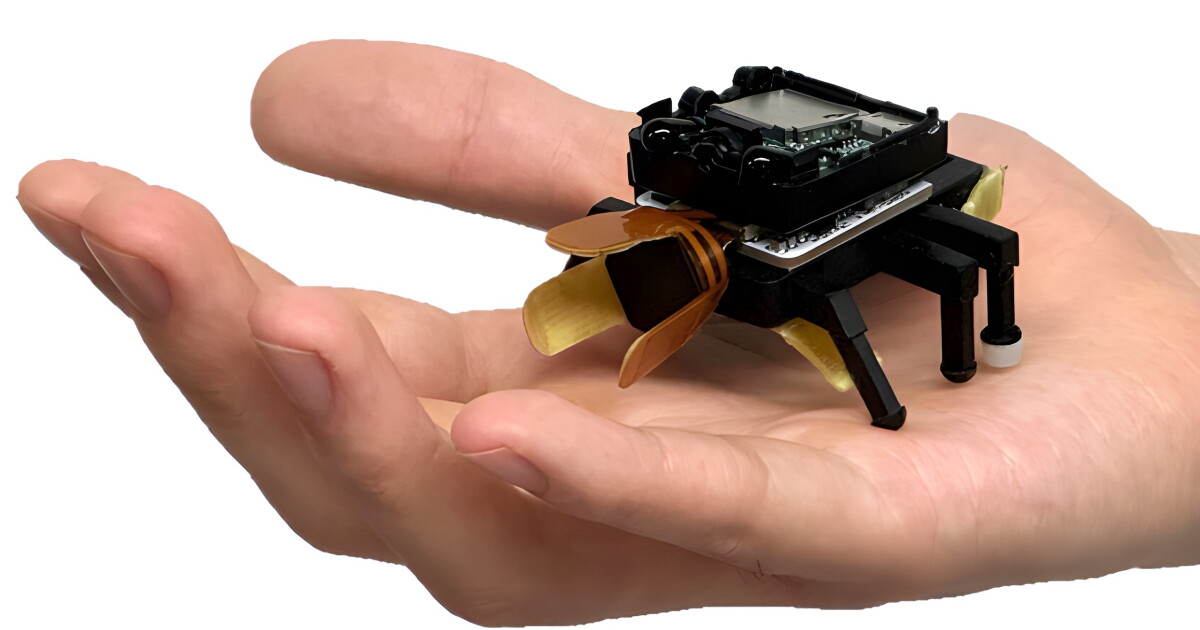

Bugs have lengthy been a supply of inspiration for robotics engineers. They’re small, agile, and might squeeze into areas the place folks can’t. Such robots are very helpful for house exploration, inspecting industrial tools, and even finishing up search-and-rescue operations. For sure functions, researchers flip actual bugs into cyborgs – which raises some moral considerations – so typically, they construct beetle-inspired robots from scratch.
A crew on the Korea Superior Institute of Science and Expertise (KAIST) has been engaged on a brand new robotic referred to as BeetleBot, and its look is not even probably the most attention-grabbing factor about it.
To design BeetleBot, researchers drew inspiration from an actual beetle referred to as Mecynorrhina torquata – one of many largest bugs on this planet, native to the Congo, Cameroon and Uganda. The scientists studied the positioning of its leg muscle mass and joints, and the way they work because the beetle strikes. Then, they utilized these ideas to their robotic.

KAIST
BeetleBot’s synthetic muscle mass are 3D-printed from a liquid crystal elastomer (LCE). What makes this materials particular is that it will probably contract and shorten by 45% when heated, after which return to its authentic form because it cools down. That’s how the pure, muscle-like motion of the robotic is achieved.
The heating mechanism is fairly attention-grabbing as a result of these LCE muscle mass want to succeed in 110 °C (230 °F) so as to contract. So, the place does this warmth come from? It’s generated by passing an electrical present by the wires built-in into the muscle mass. Despite the fact that solely these muscle mass should be heated moderately than the entire robotic, such a mechanism nonetheless requires fairly a little bit of vitality to generate that warmth. And that’s at present one of many largest challenges of the venture.
After all, BeetleBot additionally wants a human operator to manage it. To make that attainable, the researchers developed a versatile sensor patch that may be worn on an individual’s finger. When the finger strikes or bends, it stretches the patch, which, in flip, adjustments {the electrical} resistance. The management system is fairly simple and has solely 4 instructions: transfer ahead, flip left, flip proper, and grip an object.

KAIST
The gripping mechanism is fairly attention-grabbing too.
It was impressed by beetle mandibles – the jaw-like mouthparts that bugs use to seize and maintain their prey. BeetleBot’s gripper has the identical synthetic LCE muscle mass as its legs, but additionally a stress sensor. When the muscle mass contract, the gripper closes across the object, whereas the sensors assist to find out the utilized stress. The robotic is moreover outfitted with a digital camera that permits so-called bidirectional suggestions, which the researchers are notably happy with.
Prof. Inho Kim of Sungkyunkwan College, the examine’s first writer, explains, “A key characteristic of this work is the bidirectional suggestions, which hyperlinks the data detected by the robotic to the person’s subsequent motion.”
In different phrases, the robotic and the operator are always exchanging info. The robotic sends visible info from the digital camera to the human in actual time, the human responds with a sure gesture, the robotic follows the command and sends quick suggestions.
In laboratory checks, BeetleBot was in a position to navigate turns, attain an object, grip it and transport it to a different location. Sooner or later, the analysis crew goals to enhance the robotic’s response pace and vitality effectivity, and ultimately develop BeetleBot into a completely soft-bodied robotic to make it appropriate for varied environments.
Supply: KAIST