
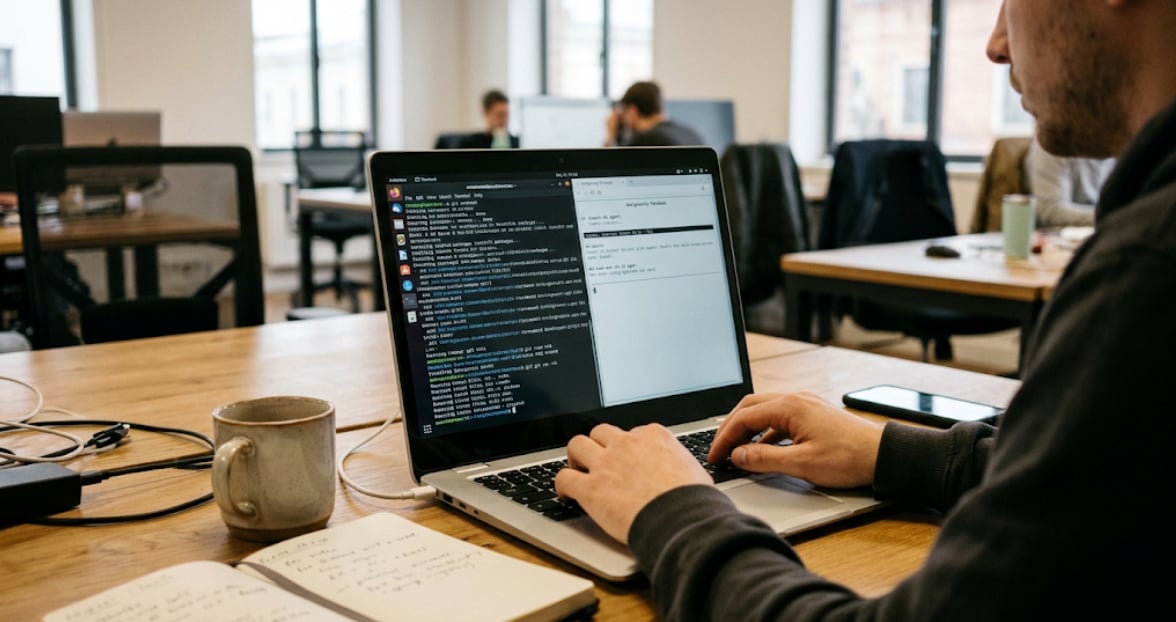

Google needs builders to construct AI-powered purposes on its new laptops, and it’s giving them one thing extra helpful than one other chatbot: a Linux atmosphere the place AI brokers can write code, set up software program, and execute instructions.
On Oct. 12, Google detailed its Linux Terminal Preview for Googlebook, a Debian-based improvement atmosphere operating inside an remoted digital machine. The characteristic helps programming instruments, net improvement, and AI brokers whereas introducing safeguards designed to guard the host working system and information that haven’t been explicitly shared with Linux.
For builders, Googlebook may turn into a extra sensible choice for coding, testing purposes, and experimenting with AI brokers. For IT groups, the larger query is whether or not its compatibility, safety controls, and efficiency justify introducing one other working system into the office.
Googlebook’s Linux Terminal is constructed for AI brokers
Google’s emphasis goes past conventional programming. It goals to offer AI brokers with a managed atmosphere through which they’ll carry out duties that usually require builders to work together with a command line.
In keeping with Google’s Oct. 12 developer announcement, AI instruments can use the terminal to put in packages, create information, run scripts, and automate improvement duties.
Google highlights Antigravity, its agentic improvement platform, as one instance.
Antigravity, which stays in beta, comes preinstalled on supported Googlebook fashions. Utilizing it requires a Google AI plan subscription, a Google Account, and an put in Terminal app. Customers have to be not less than 18; availability varies by area, and organizations could prohibit entry by way of managed accounts.
Launching Antigravity routinely opens Terminal, which should stay open whereas the AI improvement atmosphere is operating.
The Linux Terminal Preview provides a number of capabilities:
- Growth instruments: Debian package deal administration, Git, SSH, compilers, and programming runtimes together with Python, Node.js, Ruby, Go, and Rust.
- Internet improvement: Computerized localhost port forwarding lets builders entry purposes operating contained in the VM by way of the host browser.
- AI automation: Command-line brokers can execute improvement duties contained in the remoted atmosphere, topic to accessible permissions.
- File entry: Linux information seem in Googlebook’s Recordsdata app, whereas entry to chose host directories requires express authorization.
Google says its engineers have used Googlebook {hardware} to construct a Linux kernel and carry out platform engineering duties.
For builders who primarily work with terminals, repositories, and cloud infrastructure, these capabilities may make Googlebook value testing as an alternative choice to a devoted Linux workstation.
Whether or not it could actually substitute an current improvement laptop computer will rely upon software program compatibility, efficiency, and organizational necessities.
How Google protects information when AI brokers run instructions
Autonomous coding instruments can set up software program, modify information, and execute instructions. These capabilities are helpful, however additionally they pose safety dangers when an agent is granted broad system permissions. Google addresses a part of that downside by operating Linux inside a digital machine separated from Googlebook’s host working system.
The structure permits builders to grant instruments equivalent to Antigravity sudo privileges throughout the VM with out giving them equal management over the host.
Two protections are notably related.
- Host file entry requires permission. Customers should explicitly share directories with the Linux atmosphere quite than routinely exposing each file on the laptop computer.
- The VM may be eliminated and reset. Google’s restoration course of permits customers to uninstall the Linux VM picture with out reinstalling the host working system. It additionally provides a backup choice, which issues as a result of information saved contained in the eliminated VM could in any other case be misplaced.
These safeguards have limits.
An AI agent can nonetheless modify shared information, entry approved community assets, or expose credentials accessible inside its atmosphere. Builders ought to due to this fact overview shared-folder permissions, port-forwarding settings, and the credentials accessible to automated instruments.
For IT directors, the sensible lesson is that VM isolation reduces sure dangers however doesn’t substitute entry controls, safety evaluations, or oversight of AI-generated instructions.
Tips on how to arrange Linux Terminal on Googlebook
Google’s official Terminal setup information outlines a simple set up course of:
- Open the Terminal app on Googlebook.
- Choose Set up to obtain and configure the Linux digital machine picture.
- Watch for set up to complete and the terminal window to open.
- Set up the event packages wanted in your workflow.
For instance, builders can use customary Debian instructions:
sudo apt replace && sudo apt improve -y
sudo apt set up -y git python3 python3-pip nodejs
Customers can alter the VM’s allotted reminiscence by way of Terminal’s superior settings and browse Linux information by way of Googlebook’s Recordsdata app.
For builders, this offers a solution to take a look at Linux workflows with out changing the laptop computer’s working system.
IT groups ought to start with a small pilot that features consultant duties, equivalent to cloning repositories, operating native net servers, putting in accredited dependencies, and connecting to distant improvement environments.
Testing these workflows on precise {hardware} can reveal limitations earlier than a corporation invests in further gadgets.
What Googlebook’s Linux Terminal can and can’t do
Google’s announcement additionally outlines enhancements that stay underneath improvement.
| Debian Linux command-line atmosphere | Accessible in preview |
| Python, Node.js, Ruby, Go, and Rust workflows | Supported |
| Computerized localhost port forwarding | Accessible |
| Adjustable VM reminiscence allocation | Accessible |
| Linux information accessible by way of Recordsdata app | Accessible |
| GPU and NPU acceleration for Linux workloads | Deliberate |
| Linux graphical apps built-in into the principle launcher | Deliberate |
| USB passthrough and USB-based Android debugging | Deliberate |
| Dynamic VM reminiscence and storage scaling | Deliberate |
| VM persistence impartial of the terminal window | Deliberate |
Google already helps community passthrough and wi-fi Android Debug Bridge connections, however USB passthrough and USB-based ADB stay on its roadmap.
Some graphical Linux purposes may also run by way of an alternate graphics display screen inside Terminal. Nevertheless, integration with Googlebook’s principal software launcher continues to be deliberate. These distinctions matter for builders who rely upon specialised {hardware}, graphical improvement instruments, or demanding native AI workloads.
GPU and NPU acceleration may ultimately broaden the platform’s usefulness for AI improvement, however Google hasn’t established when these capabilities will arrive or how they may carry out.
For companies contemplating Googlebook purchases, the most secure strategy is to guage what the platform helps right this moment quite than making choices primarily based on promised upgrades.
What Googlebook’s Linux help means for builders and IT groups
Googlebook’s Linux Terminal Preview expands its potential usefulness, however the strongest purposes will range by staff.
- Internet builders and cloud-focused groups could discover the platform appropriate for Git, SSH, Python, Node.js, browser-based purposes, and distant infrastructure.
- AI builders achieve an remoted atmosphere for experimenting with coding brokers and command-line automation. These operating demanding native fashions should require extra highly effective {hardware} or future acceleration help.
- IT directors face a extra vital impediment: enterprise administration.
Google’s enterprise documentation states that Googlebook doesn’t at the moment help area enrollment or centralized fleet administration.
Some Google Workspace account and Chrome browser controls can be found, however Google says the primary wave of enterprise administration capabilities will start rolling out within the second half of 2027, with further controls arriving in phases.
That limitation makes Googlebook a extra real looking candidate for managed developer testing than broad enterprise deployment right this moment.
For context, TechRepublic’s ChromeOS versus Googlebook OS comparability examines variations between the platforms.
Should-read developer protection
What companies ought to test earlier than adopting Googlebook
IT groups contemplating a pilot ought to give attention to 5 questions:
- Do current workflows work? Take a look at required languages, packages, repositories, construct instruments, and distant connections.
- Are AI-agent permissions applicable? Evaluation entry to supply code, credentials, shared directories, and inside techniques.
- Does efficiency meet expectations? Evaluate construct occasions, reminiscence utilization, and responsiveness with current improvement machines.
- Are administration controls enough? Verify authentication, safety monitoring, updates, and system administration in opposition to organizational necessities.
- Are any lacking options important? Establish dependencies on GPU acceleration, USB debugging, or built-in graphical Linux purposes.
These checks lengthen past Linux. TechRepublic’s protection of early Googlebook OS evaluations highlights Android software compatibility, account switching, and Gemini limitations that companies ought to think about throughout testing.
Googlebook’s Linux Terminal Preview offers builders one other atmosphere for coding and AI experimentation. Nevertheless, Linux help alone doesn’t make the platform a substitute for established improvement laptops, notably whereas centralized fleet administration stays unavailable.
For now, managed testing provides the clearest path ahead. If Google delivers its deliberate {hardware} acceleration, deeper Linux integration, and enterprise administration capabilities, Googlebook may turn into a extra severe choice for skilled improvement groups.
Associated studying: For a broader have a look at the accessible gadgets, specs, and AI options, see TechRepublic’s Googlebook cheat sheet.