


When groups transfer knowledge and AI work to manufacturing in a shared surroundings, one query rapidly turns into unavoidable: who can do what? Amazon SageMaker Unified Studio now solutions it with designations, that are named permission units that give directors granular management over the actions every member can carry out inside a venture. Directors outline a designation as soon as, then assign it to venture members. A member would possibly sign up by means of an AWS Id and Entry Administration (IAM) function, an IAM consumer, or an AWS IAM Id Middle consumer or group. In every case, designations aid you give every persona solely the entry its duties require. Efficient entry additionally is dependent upon id and useful resource insurance policies, service management insurance policies, permissions boundaries, group memberships, and the way the client configures permission units and assignments. Designations combine with AWS CloudFormation, and there’s no further cost to make use of them past Amazon SageMaker Unified Studio itself.
On this put up, we stroll by means of why differentiated permissions matter, how designations work, and the way to create and assign your first designation utilizing the console and the AWS Command Line Interface (AWS CLI).
The problem: One venture, many roles
A single SageMaker Unified Studio venture typically brings collectively knowledge engineers, knowledge stewards, analysts, and machine studying (ML) engineers, every needing very completely different entry. Contemplate a monetary providers staff operating its Lakehouse and ML workflows in a single venture. Engineers construct and schedule extract, remodel, and cargo (ETL) pipelines, and a steward approves subscription requests to maintain delicate knowledge ruled. Analysts question curated tables for dashboards, and ML engineers iterate on fashions in notebooks. All of them work on the identical knowledge, however their entry wants differ. The steward shouldn’t alter manufacturing pipelines, analysts shouldn’t launch costly compute, and the scheduled ETL service account shouldn’t share permissions with somebody operating exploratory experiments. Up to now, widespread approaches included giving everybody the identical broad venture function or splitting the work throughout separate initiatives.
“We automated every part about how groups get arrange in SageMaker Unified Studio. Initiatives are created, members are synced from our listing day by day, and knowledge sources are registered with out anybody clicking a button. The one factor we couldn’t automate was controlling what every individual might do as soon as they have been inside. Resolution groups, knowledge scientists, and enterprise analysts all arrived with the identical entry. With designations, we now outline every consumer sort’s permissions as a part of the identical automation that creates the venture, so the suitable entry is enforced from day one.”
— Tim Kopacz, Cloud Platform Architect, Swiss Life Germany
With out a purpose-built mechanism to scope permissions inside a venture, organizations face operational threat. A consumer would possibly by accident delete a connection that disrupts a manufacturing workload or modify catalog settings outdoors their space of duty. Groups typically work round this by making a separate venture for every persona to isolate entry. That strategy fragments knowledge throughout venture boundaries and provides provisioning and member-management overhead. As extra groups onboard, these workarounds compound to sluggish adoption and improve the governance burden.
Designations handle a number of widespread eventualities:
- Controlling entry to Notebooks: Grant members full entry, read-only entry, or no entry to notebooks inside a venture, so compute-intensive interactive work is obtainable solely to the roles liable for it. This helps management prices by limiting who can run pocket book workloads.
- Separating exploration from manufacturing: Grant exploratory customers learn and discover entry whereas manufacturing service accounts run scheduled workflows, all inside the similar venture.
- Supporting governance workflows: Assign particular personas duty for knowledge stewardship, subscription approval, and metadata administration, which helps forestall different members from bypassing your assessment course of.
How designations work
Designations separate coverage definition from member project, which is what makes them reusable throughout initiatives.
- Outline as soon as: A site administrator creates a designation by deciding on granular permissions. For instance, publish an asset, create knowledge merchandise, or approve subscriptions. Permissions are grouped into classes similar to Catalog, Challenge, Subscriptions, Connections, and Notebooks, and are backed by the Cedar coverage language.
- Assign per venture: Inside a venture, the venture proprietor assigns one designation to every member. When a member performs an motion by means of the portal or the API, SageMaker Unified Studio evaluates the assigned designation. It permits or denies the motion primarily based on the permissions the designation incorporates. Moreover, a member may inherit designations by means of single sign-on (SSO) group membership. If a consumer is straight assigned one designation and in addition belongs to a bunch assigned to a different, the consumer receives the union of each permission units. As a result of efficient permissions are the union of direct and group-inherited designations, assessment SSO group assignments commonly so members don’t obtain extra entry than supposed.
As a result of a designation is outlined as soon as and assigned per venture, you get constant permissions throughout each venture with out recreating insurance policies every time. Information engineers, stewards, analysts, and automatic pipelines can work inside the similar venture with completely different permissions, which retains knowledge unified in a single place fairly than fragmented throughout duplicate initiatives.
Designations complement your current IAM controls fairly than substitute them, and so they present one constant authorization layer throughout each consumer sort that SageMaker Unified Studio helps. This issues as a result of SageMaker Unified Studio helps IAM roles, IAM customers, SSO customers, and SSO teams. You may’t connect IAM insurance policies on to SSO customers or teams inside SageMaker Unified Studio. Designations apply uniformly to all of those principals, so each consumer sort is ruled by the identical permission mannequin inside a venture.
Authorization occurs in two layers. First, IAM evaluates whether or not a principal can invoke an API on the AWS API boundary. If IAM permits the decision, the designation then evaluates whether or not the assigned permission set grants the precise motion inside the venture. You don’t want to change your current IAM insurance policies to undertake designations, however we nonetheless advocate that you just proceed to scope IAM roles to least privilege.
For instance, the AmazonSageMakerDomainExecution function would possibly maintain the IAM permission to carry out an API motion similar to datazone:CreateListingChangeSet, the permission to publish an information asset. The following layer is the designation: the motion succeeds provided that the venture member’s designation contains the Handle Asset Publishing permission to publish property in that venture. Each layers should enable the motion, and an IAM Deny blocks the decision no matter what the designation permits.
The next diagram exhibits how a venture member’s request to publish an information set passes by means of each authorization layers.
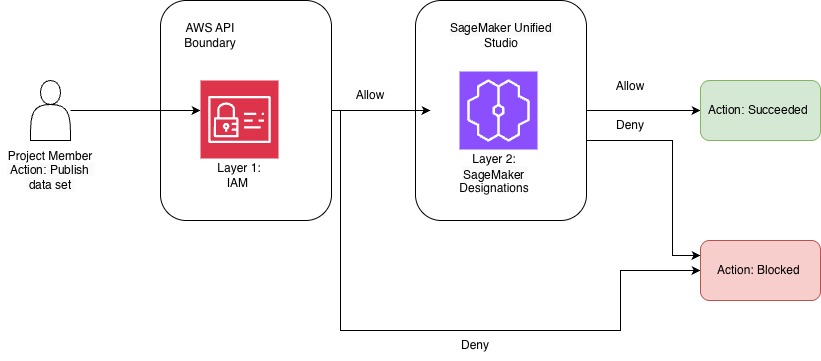
Determine 1: How a request to publish an information set passes by means of the IAM and designation authorization layers
The request first reaches the AWS API boundary, the place IAM (layer 1) evaluates whether or not the principal can name the API. If IAM denies the decision, the motion is blocked. If IAM permits it, SageMaker Unified Studio (layer 2) evaluates the member’s designation. The motion succeeds solely when the designation additionally permits it. In any other case, the motion is blocked.
Managed designations
Each area contains two AWS managed designations on the venture stage so you can begin instantly:
- Proprietor – Full management over all venture assets, together with venture member administration.
- Contributor – Full entry aside from venture member administration and venture deletion. As a result of Contributor is broad, we advocate customized designations for personas that don’t want full entry.
You may view the permissions for these managed designations, however you possibly can’t edit or delete them. To create your personal permission units, you construct customized designations for the personas your group wants.
Create a designation on the console
Designations are created and managed from the area administration portal. Solely customers whose profile is a site administrator can entry it. The area administration portal is separate from the Amazon SageMaker Unified Studio portal the place members do their day-to-day work. On this instance, we create an ML Engineer designation for members who construct workloads by means of notebooks.
- Register to the SageMaker Unified Studio area administration portal.
- Within the navigation pane, select Designations. The Managed tab exhibits the AWS managed Proprietor and Contributor designations.
- Select Create designation.
- For Title, enter
ML Engineer, and add a Description. - Within the visible permission selector, broaden the Pocket book class and choose solely the permissions this persona requires, for instance, Learn-only actions for reviewers, or All Actions just for members who writer notebooks.
- Select Create.
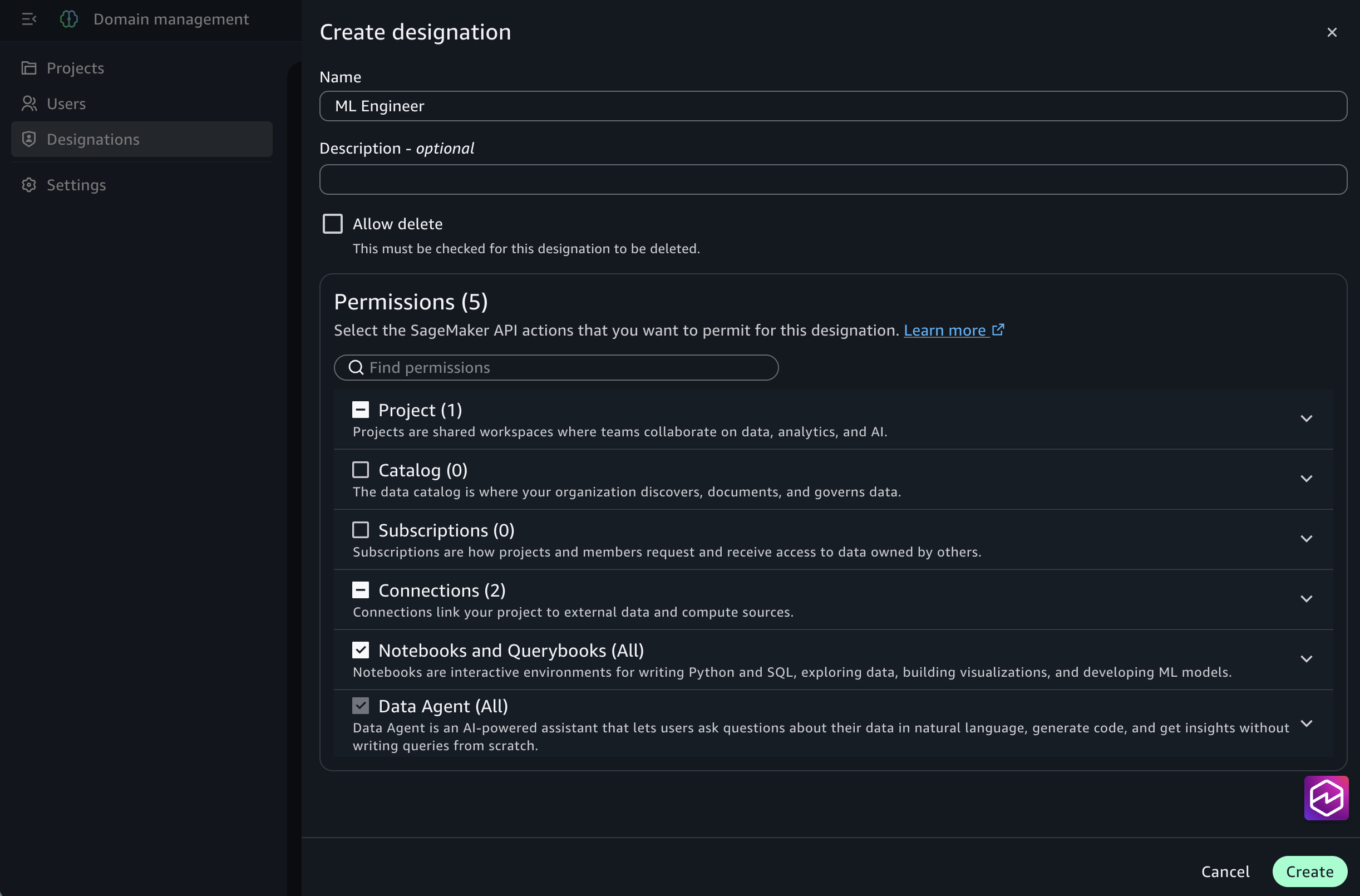
Determine 2: Making a designation within the Amazon SageMaker Unified Studio area administration portal, utilizing the visible permission selector to decide on the actions to incorporate
The ML Engineer designation is now out there to each venture within the area. You may as well create a designation by duplicating an current one, which pre-selects a set of permissions so that you can customise. Evaluate the pre-selected permissions and take away any that the brand new persona doesn’t want.
Assign a designation to a venture member
After creation, a designation is obtainable to each venture within the area. You may assign it from two locations, relying in your area sort.
From the SageMaker Unified Studio portal (Id Middle-based domains), assign the designation from a venture the place you might be an proprietor, or in case your designation has the Handle Membership permission. Grant Handle Membership solely to trusted venture members. A member who has the Handle Membership permission can assign designations with extra permissions than their very own.
- Navigate to the venture within the SageMaker Unified Studio portal.
- Select the Members tab.
- To replace an current member, select a designation from the Designation column for that consumer. So as to add a brand new member, select Add member and choose the member.
- For Designation, select ML Engineer.
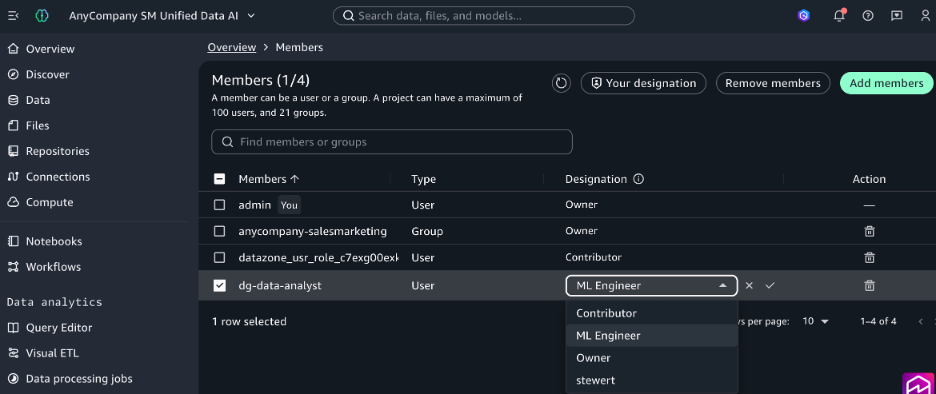
Determine 3: Assigning a designation to a venture member from the Amazon SageMaker Unified Studio portal (Id Middle-based domains) utilizing the Position listing on the Members tab
From the area administration portal (each IAM and Id Middle-based domains):
- Register to the area administration portal and select Initiatives within the navigation pane.
- Choose the venture, then select the Members tab.
- To replace an current member, select a designation from the Challenge designation column. So as to add a brand new member, select Add members and choose the sort and member.
- For Designation, select the designation to assign, then select Save.
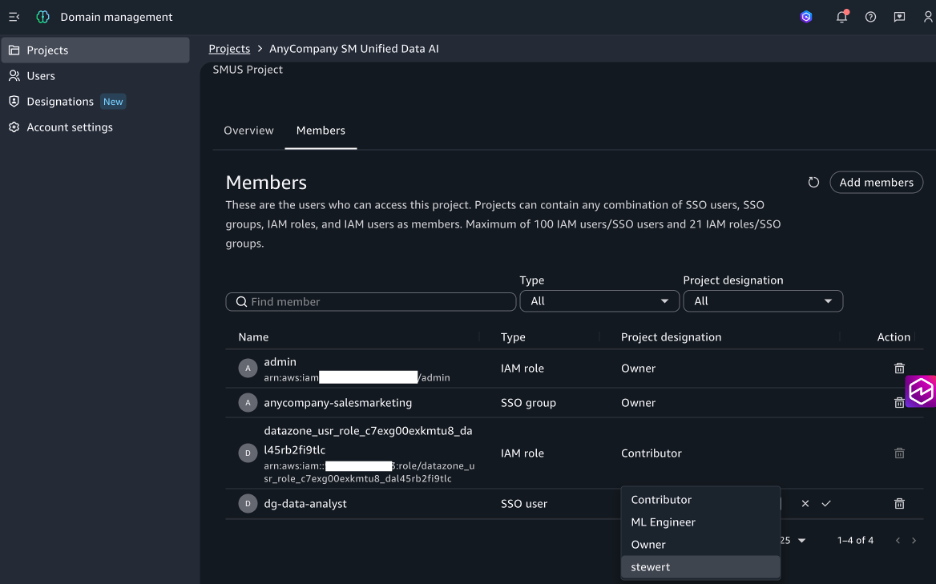
Determine 4: Assigning a designation from the area administration portal (each IAM and Id Middle-based domains) utilizing the Challenge designation column on the Members tab
When the assigned consumer logs in to the venture, they’re permitted to create notebooks. Each venture member is assigned a designation. Members with out a legitimate designation don’t have any permissions within the venture.
Automate the complete lifecycle with the AWS CLI and infrastructure as code (IaC)
You may handle your complete lifecycle, from making a designation to assigning it, programmatically. That is helpful for codifying governance and rolling it out at scale.
Conditions:
The IAM principal that runs these instructions wants permissions (scoped to the area) similar to datazone:CreateDesignation, datazone:UpdateDesignation, and datazone:DeleteDesignation to handle designations. They want datazone:CreateProjectMembership to assign the designation to venture members. Grant solely the actions you want.
Create a designation with the AWS CLI:
Assign the designation whenever you add a member to a venture:
As a result of designations are supported as assets in AWS CloudFormation, you possibly can outline them in your templates, model them in supply management, and deploy them throughout domains by means of your current infrastructure-as-code pipelines. You may as well handle assignments with the CreateProjectMembership and UpdateProjectMembership API operations, so the complete workflow could be automated with out utilizing the console.
Replace designations as your wants evolve
Once you replace a designation’s permissions, the change takes impact instantly for all members assigned that designation throughout all initiatives, with no reassignment required. This implies you can begin with the minimal permissions every persona wants, and add permissions as necessities or new capabilities emerge. As a result of updates apply instantly throughout all initiatives, assessment designation modifications by means of your change-management course of and use AWS CloudTrail to audit them.
Delete a designation
Designations embrace an Permit delete property that’s turned off by default, so a designation can’t be deleted till you explicitly enable it. Once you create or edit a designation, set Permit delete to make the designation eligible for deletion. As soon as allowed, you possibly can delete the designation even when venture members are nonetheless assigned to it.
Once you delete a designation that’s nonetheless in use, these members stay within the venture, however their assigned designation turns into invalid. They don’t have any permissions within the venture till the venture proprietor reassigns them a sound designation. Plan deletions accordingly so members will not be left with out entry.
You may as well set this property programmatically. The CreateDesignation API and AWS CLI settle for a deletion safety parameter, so you possibly can codify the setting in your infrastructure as code templates.
To create the designation with out delete safety, use the --no-deletion-protection flag.
Conclusion
Designations give directors management over who can do what inside every Amazon SageMaker Unified Studio venture. Outline named permission units as soon as and assign them per venture to assist implement separation of duties throughout knowledge engineers, stewards, analysts, ML engineers, and automatic pipelines. You don’t have to duplicate initiatives or construct a permission system outdoors SageMaker Unified Studio. Designations require no further infrastructure or price, combine with AWS CloudFormation, and layer cleanly on high of your current IAM controls.
To get began, open the area administration portal in your Amazon SageMaker Unified Studio area, select Designations, and create your first permission set. To study extra, see the Amazon SageMaker Unified Studio documentation.
Concerning the authors