



As AI brokers develop into extra succesful and their use expands throughout cybersecurity and different domains, the necessity for efficient analysis grows. An agent investigating a codebase makes a sequence of selections: the place to look, which instruments to make use of, tips on how to interpret the proof, and when to submit a discovering. Evaluating that work requires clear job definitions, constant execution situations, and a option to look at each the method and the end result.
We’re introducing Agentic FAITH, an extension of Cisco Basis AI’s FAITH analysis framework. It brings duties that require a number of steps and gear use into the identical framework groups already use for question-answering benchmarks. Researchers and engineers can now use one workflow to run cybersecurity evaluations, grade outcomes, and analyze outcomes throughout each sorts of duties.
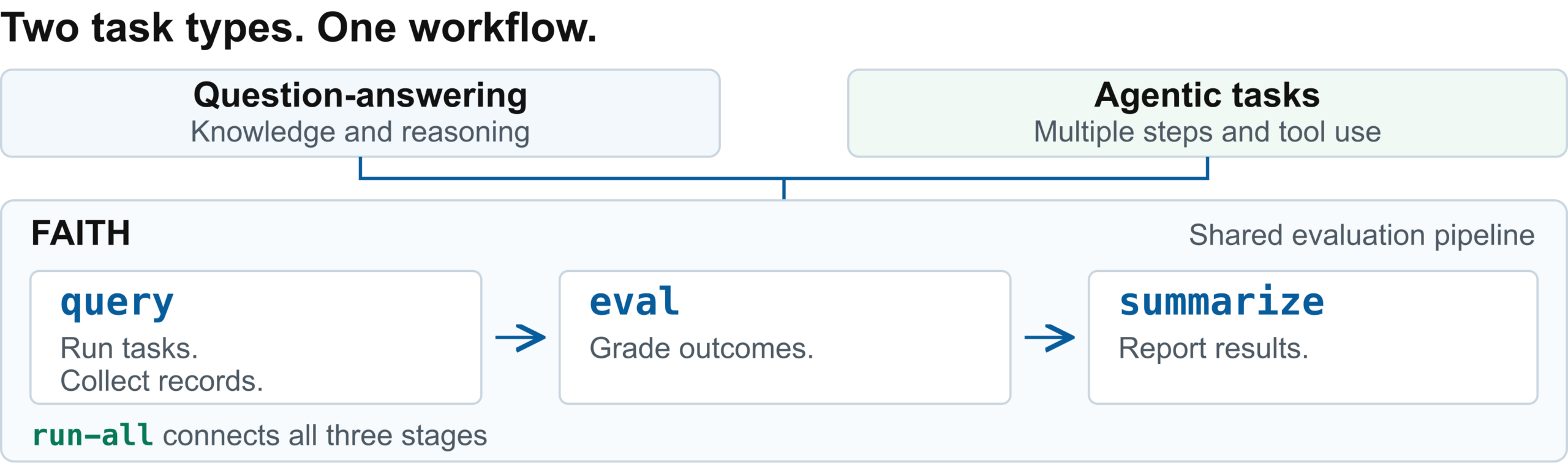 Determine 1. Conventional and agentic benchmarks share a workflow, with every benchmark defining its personal duties and scoring.
One workflow for cybersecurity evaluations
FAITH already brings cybersecurity benchmarks for risk intelligence, vulnerability classification, and safety data into a typical analysis workflow. Agentic help extends that workflow to duties resembling exploring a repository with terminal instruments, giving groups one framework for working and analyzing each conventional and agentic evaluations.
The workflow stays acquainted: question runs the benchmark and collects data, eval grades the outcomes, and summarize stories the outcomes. The run-all command combines these phases. Groups utilizing FAITH can run and analyze their new agentic benchmarks by these similar instructions.
For agentic duties, FAITH manages the interplay between the mannequin and its instruments. The mannequin chooses an motion, receives the software’s output, and makes use of that consequence to determine what to do subsequent. A run continues till the agent submits a solution or reaches a stopping situation outlined by the benchmark.
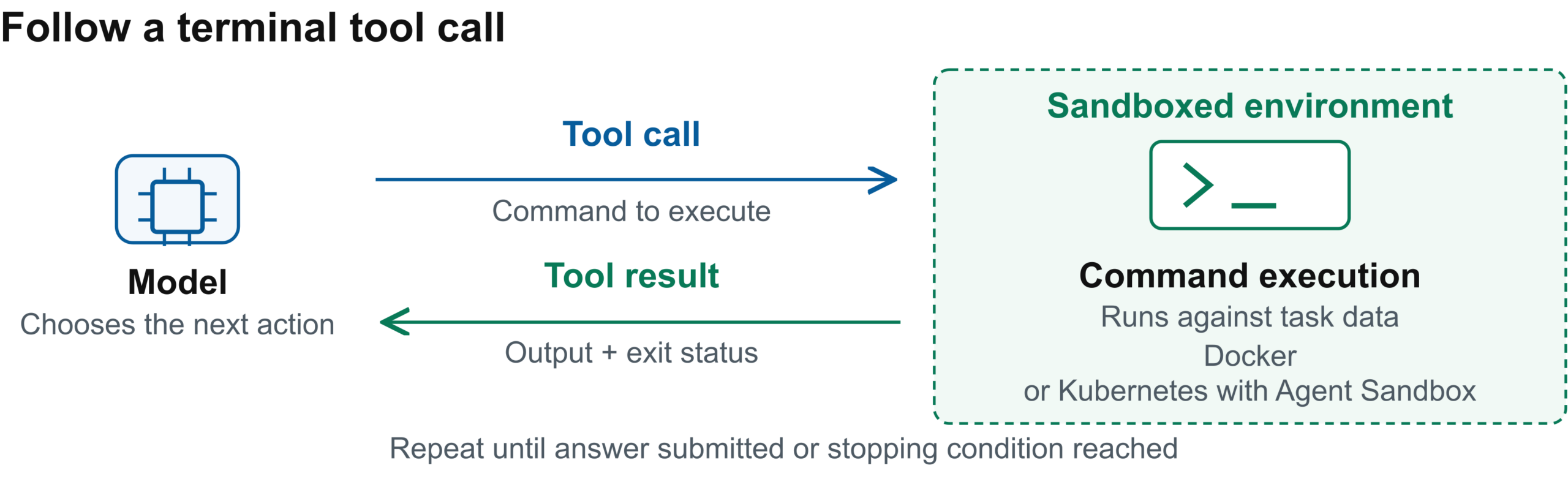 Determine 2. For terminal instruments, FAITH dispatches the decision to the configured setting and returns the consequence to the mannequin. It data these interactions for later inspection.
See it in motion with VulnLoc
The primary built-in agentic benchmark is VulnLoc, which evaluates how effectively brokers find susceptible information in a repository and keep away from false alarms on patched code.
Every job offers the agent a repository snapshot and an outline of a vulnerability class. The agent explores the code by terminal instruments, searches for related logic, and follows what it finds. It then submits the information it suspects comprise the vulnerability or explicitly stories that it discovered no matching vulnerability.
VulnLoc can run domestically with Docker for trusted inputs or on Kubernetes by Agent Sandbox. The execution setting enforces read-only entry to the repository.
FAITH integrates each phases of the benchmark:
- Part A: discover the affected information. The agent inspects the repository earlier than a safety repair. File-set F1 measures how effectively its submitted information match the benchmark’s floor fact, accounting for each missed information and incorrect picks.
- Part B: acknowledge the repair. The agent inspects the corresponding patched repository and stories that the desired vulnerability is absent. The first metric is true-negative price.
Collectively, these phases consider the flexibility to seek out vulnerabilities and keep away from false alarms on patched code. Completion standing is recorded so an accurate report of no matching vulnerability will be distinguished from a lacking submission or an execution failure.
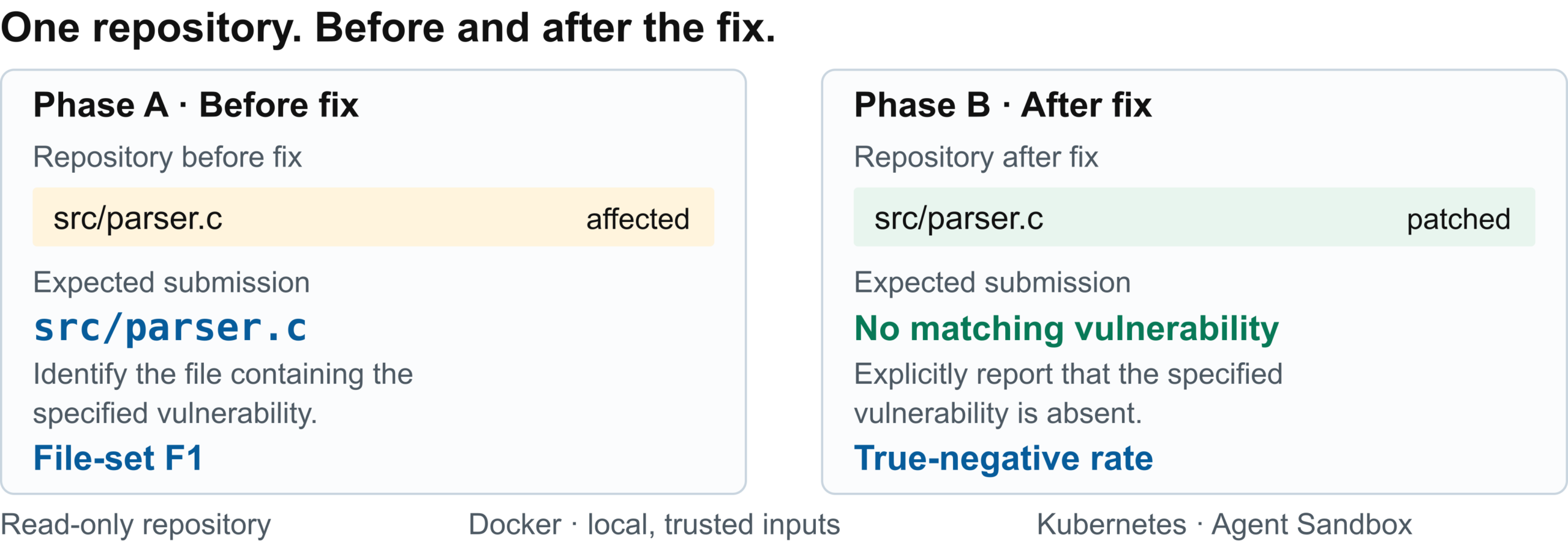 Determine 3. File paths and submissions are illustrative.
Construct evaluations round your duties
VulnLoc is the primary integration in an extensible benchmark structure. Benchmark authors can outline how duties are loaded, which instruments an agent can use, the place these instruments execute, and the way submissions are extracted and scored. They’ll reuse current elements or implement and register new ones in FAITH.
Benchmarks additionally configure prompts, flip limits, tool-call budgets, and timeouts. Making these situations specific helps groups perceive the setup behind a consequence and consider fashions below a constant set of constraints.
Deployment configuration can override the benchmark’s default setting, letting groups adapt the execution setup whereas holding the duty definition intact.
Perceive every run and hold your progress
FAITH saves the dialog historical past, software calls and responses, submitted solutions, execution errors, and the explanation every job ended. If an agent misses a susceptible file, researchers can look at whether or not it inspected that code, what info it acquired, and whether or not it exhausted its execution funds. These data assist groups examine failures and determine adjustments to discover in subsequent evaluations.
Lengthy evaluations additionally profit from completed-task checkpointing. FAITH saves every accomplished job earlier than beginning the subsequent one. When that storage stays obtainable, an interrupted analysis can reuse eligible accomplished outcomes. Work resumes at job boundaries, decreasing the necessity to repeat accomplished duties after an interruption.
Get began with Agentic FAITH
The new FAITH technical documentation brings collectively set up directions, an agentic quickstart, mannequin configuration, deployment steerage, and directions for creating benchmarks.
Begin with a small VulnLoc analysis. Select a mannequin and endpoint that help structured software calls by the OpenAI-compatible Chat Completions interface, configure the Docker setting, and run a job. Agentic FAITH helps hosted endpoints and appropriately configured fashions served by a appropriate API. Examine the saved execution file alongside the rating earlier than increasing the analysis.
Get began with the Agentic FAITH quickstart, discover the code on GitHub, and contribute the benchmarks you need to consider subsequent. We’re constructing a typical framework for the rising vary of the way AI methods are utilized in cybersecurity, and we welcome benchmarks that assist the neighborhood measure these capabilities.