


I keep in mind sitting in a windowless convention room late one Thursday night, the whiteboard buried below messy structure diagrams. That evening captured the entire drawback with cloud migration in a nutshell. The push towards digital transformation makes the cloud really feel just like the end line for each piece of tech a enterprise owns. Straightforward to get swept up in that momentum. Straightforward to imagine migrating every part is the apparent path. Leaders hear about infinite scalability and decrease upkeep prices. They watch rivals make the leap and really feel the strain to observe. However is a mass migration actually the silver bullet everybody claims?
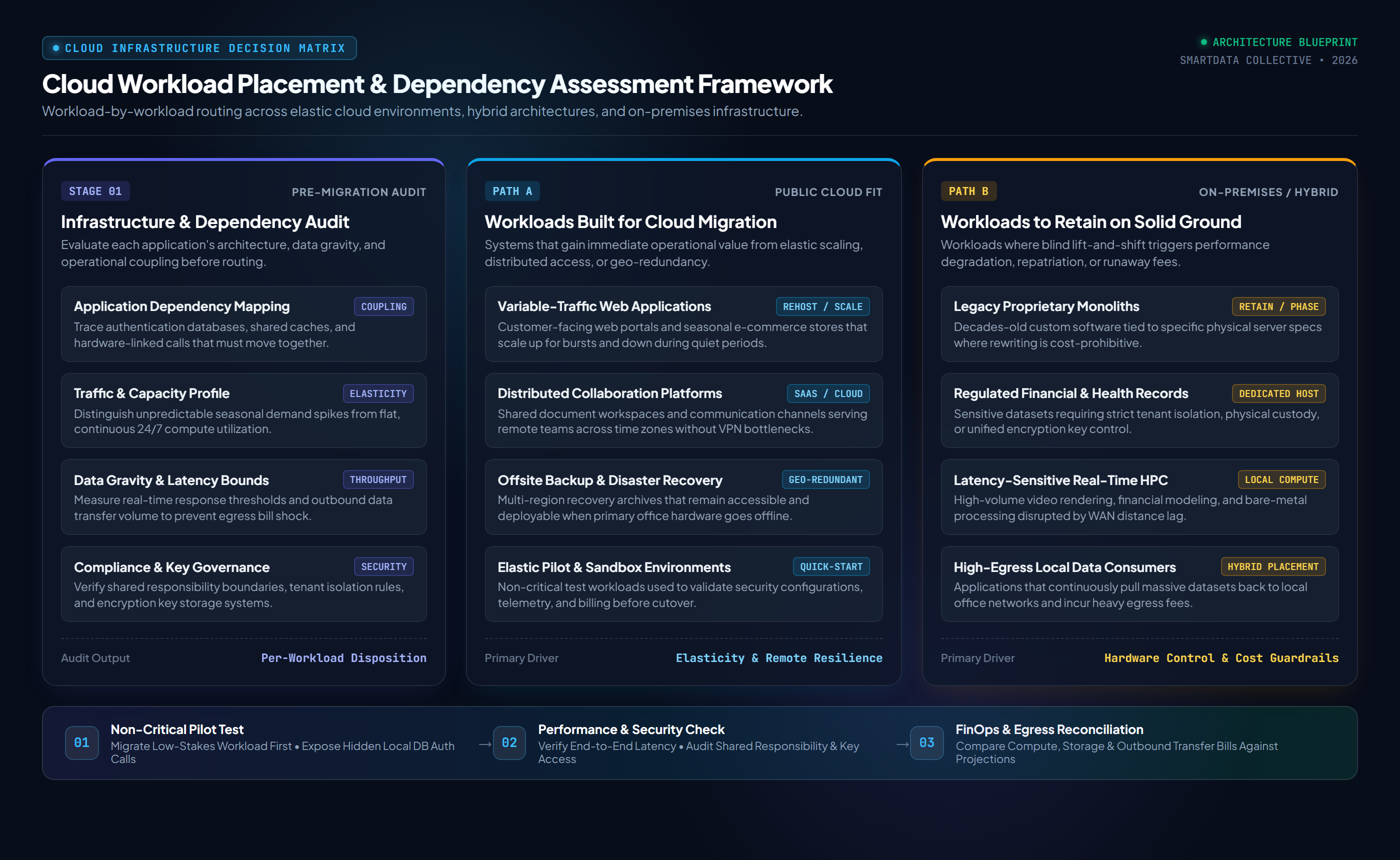
Variable-traffic net functions, distant collaboration instruments, and offsite catastrophe restoration are prime cloud migration workloads. Legacy monoliths with {hardware} dependencies, regulated datasets, and latency-sensitive computing typically match higher on-premises or in a hybrid cloud mannequin. Conduct a cloud readiness evaluation and software dependency mapping earlier than testing non-critical workloads first.
Actually, the fact is much extra nuanced. Transferring your programs isn’t a common repair for each technical problem. Some programs thrive in a decentralized setting. Others lose effectivity and switch into pricey burdens.
Understanding the distinction is the true basis of a sensible expertise technique. Deciding on cloud migration workloads begins with a cloud readiness evaluation that maps software structure, knowledge gravity, compliance boundaries, and consumer latency thresholds.
- Utility dependency mapping: Hint authentication databases, shared caches, and storage places earlier than selecting which cloud migration workloads transfer first.
- Elastic cloud candidates: Prioritize variable-traffic net apps, distributed collaboration instruments, and geo-redundant backup and restoration.
- On-premises or hybrid retention: Consider legacy software program, regulated data, and high-throughput computing to stop cloud repatriation and shock egress charges.
- Phased pilot validation: Take a look at non-critical workloads in phases and reconcile precise compute, storage, and switch payments earlier than full cutover.
Assessing Your Present Infrastructure
Earlier than transferring a single file or software, you want an intensive cloud migration evaluation of your current setting. Know precisely how your programs work together and the place your knowledge truly lives. Many organizations rush this part. They find yourself untangling advanced dependencies after the migration has already began, often whereas looking at error logs at two within the morning. That all the time results in surprising downtime and inflated budgets. Consider the structure of every workload independently. Some functions had been constructed many years in the past and depend on particular {hardware} configurations that can not be simply replicated nearly. Others are closely custom-made, and transferring them requires an entire rebuild.
Performing software dependency mapping saves numerous hours of troubleshooting later. It helps you establish which elements of your infrastructure are agile sufficient for a managed transition. And it clearly reveals you which of them require extra cautious planning. For organizations coping with intricate legacy programs and sophisticated knowledge necessities, an out of doors perspective is commonly a smart alternative. Utilizing hybrid cloud consulting companies will help you construct a roadmap that aligns together with your particular operational wants. That degree of knowledgeable planning retains your migration deliberate and measured, avoiding a rushed and chaotic transfer.
Workloads That Are Good for Migration
Sure functions are virtually begging to be moved off your native servers. Something that experiences unpredictable spikes in site visitors is a chief candidate when migrating workloads to the cloud. Suppose customer-facing net functions or seasonal e-commerce platforms. Conserving these on native servers means paying for max capability all 12 months spherical simply to deal with a number of weeks of heavy site visitors. Does that basically make monetary sense? The cloud permits you to scale assets up when demand is excessive and scale them again down when issues are quiet. That elasticity is among the most vital benefits of a decentralized infrastructure.
Collaboration instruments and communication platforms additionally belong on this new setting. The trendy workforce is more and more distant and distributed throughout completely different time zones. Staff want dependable entry to shared paperwork and communication channels from any location. Internet hosting these instruments domestically creates bottlenecks. It additionally introduces safety vulnerabilities when customers attempt to join from outdoors the company community. Decentralized environments are designed particularly to deal with distributed entry securely and effectively.
Information backup and catastrophe
restoration programs are one other glorious match. Counting on bodily tapes or native secondary servers introduces a large threat. If a pure catastrophe or {hardware} failure hits your major facility, you could possibly lose every part. Distant storage supplies geographic redundancy when your backup configuration locations copies in separate places. In case your important workplace goes offline, these offsite backups stay accessible and able to deploy. That’s precisely what brings peace of thoughts.
Workloads That Ought to Keep on Strong Floor
Regardless of the plain advantages of migration, some workloads ought to stay precisely the place they’re. Legacy
programs are the most typical instance. Many mature companies depend on proprietary software program that was custom-built lengthy earlier than trendy digital environments even existed.
However what occurs if you attempt to power outdated code into new infrastructure?
Making an attempt a blind carry and shift cloud migration for these programs typically leads to poor efficiency and surprising outages. Rewriting them is commonly extremely costly and time-consuming. Flexential’s migration threat evaluation notes that forcing legacy workloads into an unsuitable setting results in efficiency degradation, regulatory friction, and expensive cloud repatriation. In lots of instances, it makes extra enterprise sense to maintain them working domestically till they are often naturally phased out and changed.
Cloud’s nice for quick-starts, sure solutions, shortly spinning up functions, testing, and studying.
Jon Collins, VP of Engagement at GigaOm, in IT Professional
Extremely delicate knowledge additionally requires cautious consideration. Monetary data and private well being info are topic to strict regulatory compliance requirements. Whereas main suppliers supply robust safety controls, the shared
duty mannequin means you might be nonetheless accountable for the way that knowledge is configured and accessed. Devoted {hardware} or native internet hosting could also be required the place compliance guidelines limit multi-tenant placement, particularly since 47% of enterprises depend on fragmented key storage programs throughout hybrid environments. Conserving this delicate info on native servers provides you direct management over bodily and digital safety protocols.
Excessive-performance computing workloads with huge knowledge necessities may also battle after migration. Purposes that course of large volumes of information in actual time, like superior video rendering or advanced monetary modeling, require extremely low latency. The bodily distance between your workplace and the distant servers can introduce lag that disrupts these time-sensitive processes. And the price of transferring huge quantities of information forwards and backwards can shortly grow to be astronomical as a consequence of egress
charges.
Cloud workload placement comparability
| Workload Class | Really useful Placement | Major Architectural Driver |
|---|---|---|
| Variable-traffic net functions | Public Cloud (Rehost / Auto-Scale) | Elastic capability that scales up and down with seasonal demand |
| Collaboration and communication | Public Cloud / SaaS | Distributed distant entry throughout time zones with out VPN bottlenecks |
| Backup and catastrophe restoration | Public Cloud or Hybrid | Geo-redundant offsite copies accessible throughout a facility outage |
| Legacy proprietary monoliths | Retain On-Premises | Tightly coupled {hardware} dependencies and excessive refactoring prices |
| Regulated monetary and well being knowledge | On-Premises or Devoted Hybrid | Strict tenant isolation, shared duty, and key custody |
| Information-heavy, latency-sensitive HPC | On-Premises or Edge Colocation | Sub-millisecond native latency and avoidance of outbound egress charges |
Testing and Validation Earlier than Full Deployment
After you have recognized the best candidates for migration, the subsequent essential step is testing. You may’t merely flip a swap and anticipate every part to work completely. A phased method is all the time the most secure route. Begin by transferring a non-critical workload. This permits your workforce to get comfy with the brand new setting with out risking core enterprise operations. You may monitor efficiency, take a look at your safety configurations, and perceive the billing metrics in a low-stakes situation.
This testing part typically reveals hidden dependencies that had been fully missed throughout the preliminary audit. You may uncover {that a} seemingly unbiased net software truly depends on an area database for authentication. Discovering these points throughout a pilot program is a minor inconvenience.
Discovering them throughout a full-scale deployment is a significant disaster.
Take the time to validate each assumption you made throughout the planning part. Be sure that the efficiency matches your expectations and that the prices truly align together with your price range projections.
The Monetary Actuality of Migration
Price is commonly the first driver for migration, but it’s additionally essentially the most misunderstood side of the method. The promise of paying just for what you employ is extremely interesting. Nonetheless, with out cautious administration, month-to-month bills can spiral uncontrolled quick. IBM’s cloud migration budgeting steering stresses accounting for each preliminary transition bills and ongoing consumption run charges. It is vitally simple for builders to spin up new servers and neglect to close them down. These deserted assets proceed to accrue costs each single hour. Are you ready to observe each single occasion?
You should set up strict governance and monitoring earlier than transferring your workloads. You want a transparent understanding of the pricing fashions, together with compute time, storage tiers, and knowledge switch charges. Transferring knowledge into a brand new setting is often free. Taking it out typically comes with a hefty price ticket. Should you migrate a workload that continually pulls giant quantities of information again to your native community, your month-to-month invoice will skyrocket.
Making the Proper Strategic Alternative
Deciding which workloads to maneuver isn’t a easy technical guidelines. It’s a deeply strategic enterprise resolution that impacts your price range, your safety, and your day by day operational effectivity. It’s important to weigh the agility of recent infrastructure towards the soundness and management of native servers. There may be completely no disgrace in adopting a hybrid method. Actually, protecting sure programs native whereas migrating others is commonly essentially the most pragmatic and profitable cloud migration technique.
Take the time to investigate your particular wants. Don’t let business hype push you right into a migration that doesn’t make sense to your group. Consider every software by itself deserves towards your dependency map and pilot outcomes. Think about the long-term compute, storage, and switch prices alongside the affect in your day by day operations. By taking a measured and important method, you may seize the benefits of decentralized computing with out sacrificing the reliability of the programs that preserve your enterprise working.
FAQ
Which workloads are greatest fitted to cloud migration?
Workloads greatest fitted to cloud migration embrace customer-facing net functions with variable site visitors, distributed collaboration instruments, and offsite backup and catastrophe restoration programs. These cloud migration workloads profit instantly from elastic auto-scaling, distant accessibility, and geographic redundancy with out requiring fixed peak {hardware} capability on-premises.
Which workloads ought to keep on-premises?
Workloads that ought to keep on-premises or in a hybrid setting embrace legacy proprietary functions with strict {hardware} dependencies, regulated monetary or well being data requiring devoted tenant isolation, and latency-sensitive real-time computing that might incur heavy outbound egress charges if hosted remotely.
How do I determine which workloads to maneuver to the cloud?
To determine which workloads to maneuver to the cloud, begin with a cloud readiness evaluation and software dependency mapping throughout your infrastructure. Consider site visitors patterns, compliance boundaries, latency thresholds, and knowledge switch prices, then take a look at a non-critical pilot workload to confirm efficiency and billing earlier than full deployment.