



Knowledge governance has moved far past the area of IT groups and compliance departments. In the present day, it’s a strategic enterprise concern that impacts development, danger, buyer belief, operational effectivity, and enterprise worth. As enterprise information property develop throughout cloud repositories and automatic pipelines, company administrators are anticipated to confirm how information is systematically managed, audited, and aligned with long-term strategic targets.
What places information governance on the board agenda
Your board’s choices about information attain past compliance spending. Inaccurate experiences have an effect on technique, unclear possession delays corrections, and delicate information create publicity wherever your organization shops or shares them. NACD’s dialogue of steady information oversight additionally identifies AI dangers involving de-anonymization, unauthorized cross-border transfers, and autonomous brokers performing on delicate information.
- Asset worth: Pricing, buyer engagement, and enterprise reporting rely on correct, accessible, correctly managed information.
- Regulatory publicity: Knowledge assortment, use, and storage want insurance policies and accountable house owners, with board oversight of acceptable danger and mitigation budgets.
- Cybersecurity and AI: Administration should know the place delicate data resides and who can entry it. AI provides questions on permitted use, equity, and accountability.
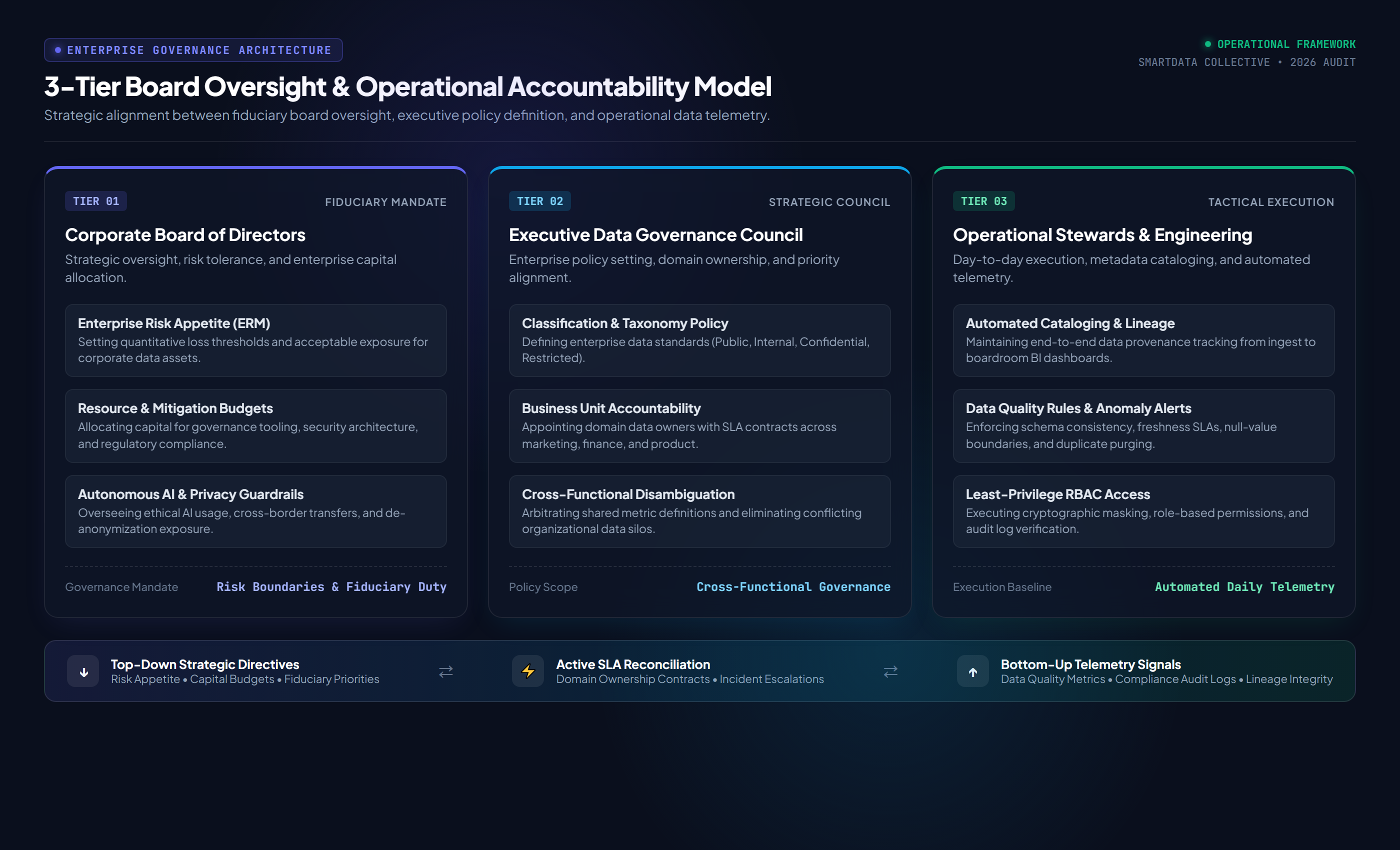
- Oversight with out every day approvals: Administrators monitor administration’s progress on information dangers. Operational groups deal with points and implement the requirements that information every day work.
Poor information governance creates extreme operational, authorized, and monetary publicity throughout the enterprise. Firms completely should know the place delicate data resides, who can entry it, how it’s used, and whether or not it helps correct decision-making. For instance, you would possibly cross-reference
litigators in opposition to Trestle’s tcpa litigator checklist as a part of a broader danger administration course of when evaluating compliance publicity. For boards, this degree of oversight is usually central to defending the corporate’s repute and monetary well being.
Knowledge Is a Core Enterprise Asset
For a lot of firms, information is certainly one of their most precious property. It informs pricing, buyer engagement, product improvement, provide chain choices, fraud prevention, and market enlargement. Nevertheless, information solely creates worth when it’s correct, accessible, safe, and correctly managed.
With out sturdy governance, organizations usually battle with duplicate information, outdated data, inconsistent reporting, and unclear possession. By establishing a dependable information governance basis, management eliminates reporting discrepancies and missed alternatives. A board that understands information governance can higher assess whether or not the group is really positioned to make use of information as a aggressive benefit.
Regulatory Stress Is Growing
Privateness and information safety rules proceed to develop throughout the US and globally. Legal guidelines such because the California Shopper Privateness Act, state-level privateness statutes, industry-specific guidelines, and worldwide rules just like the GDPR have raised expectations for the way firms deal with private data. Additional, world governments are working to introduce regulatory frameworks that match new AI applied sciences, which can doubtless make information governance extra essential than ever.
Boards should be sure that administration has applicable insurance policies, controls, and accountability buildings in place. Failing to adjust to information rules can lead to fines, lawsuits, consent orders, and reputational injury. Extra importantly, regulators more and more anticipate senior management and boards to exhibit lively oversight of data-related dangers.
Cybersecurity and Knowledge Governance Are Related
Cybersecurity usually receives board consideration, however information governance is a vital a part of the identical dialog. A corporation can not defend information successfully if it doesn’t know what information it has, the place it’s saved, how lengthy it needs to be retained, or who’s answerable for it.
Robust governance helps higher cybersecurity by lowering pointless information retention, limiting entry to delicate data, and enhancing incident response. If a breach happens, firms with well-governed information environments are sometimes higher ready to evaluate the affect, notify affected events, and reply to regulators.
AI Has Raised the Stakes
The fast adoption of synthetic intelligence has made information governance much more essential. AI methods rely on giant volumes of knowledge, and the standard of that information instantly impacts the standard, equity, and reliability of AI-driven outcomes.
Boards are more and more asking questions on AI danger, together with bias, explainability, information privateness, mental property, and accountability. These points can’t be addressed by expertise alone. They require governance frameworks that outline acceptable information use, set up evaluate processes, and be sure that AI initiatives align with moral, authorized, and enterprise requirements.
Higher Governance Improves Resolution-Making
Executives and administrators depend on experiences, dashboards, and analytics to make crucial choices. If the underlying information is incomplete or inconsistent, management could also be performing on a distorted view of the enterprise.
Boards ought to interact with administration to grasp how the corporate evaluates dangers—from regulatory publicity to reputational affect—associated to its information assortment, use, and storage. These dangers needs to be measured in opposition to an enterprise danger administration framework, with the board setting express expectations for acceptable danger, allocating capital for mitigation, and actively monitoring remediation progress.
Beth George, Christine Lyon, and Pam Marcogliese in Harvard Legislation Faculty Discussion board on Company Governance
Efficient information governance creates widespread definitions, clear information possession, and high quality requirements throughout the enterprise. When management prioritizes engineering belief into enterprise information methods, decision-makers acquire verified confidence in reporting metrics and strategic forecasting. For boards, reliable information is important for evaluating govt efficiency, setting technique, and monitoring enterprise danger.
Buyer Belief Is determined by Accountable Knowledge Use
Customers are extra conscious than ever of how firms gather and use their private data. A single information misuse incident can undermine years of brand-building. Prospects need transparency, management, and assurance that their information is being dealt with responsibly.
Board-level consideration to information governance indicators that the group takes belief severely. It additionally encourages the enterprise to construct privateness, safety, and moral information use into merchandise and buyer experiences from the start.
Making Knowledge Governance a Board Precedence
Whereas company boards delegate day-to-day information stewardship to operational administration, administrators keep fiduciary accountability for enterprise danger urge for food, regulatory compliance, and inside controls. Efficient board oversight facilities on basic governance vectors: establishing express area information possession, validating automated data-quality metrics, approving mitigation budgets, and guaranteeing synthetic intelligence initiatives function inside verified moral and authorized boundaries.
Board-level oversight and operational obligations
A disputed enterprise definition or routine entry request mustn’t routinely look forward to board approval. OvalEdge distinguishes a strategic governance council from an operational committee: the council units course and overarching insurance policies, whereas the committee resolves points, enforces requirements, and aligns stakeholders. This offers your staff a distinction between choices about coverage and the work of making use of it.
The information governance board working mannequin assigns insurance policies, requirements, accountabilities, priorities, and exceptions to the governance board, whereas preserving particular person definitions, entry requests, and high quality fixes on the lowest applicable degree. That inside governance physique has a distinct remit from the company board of administrators, whose oversight contains danger urge for food, mitigation budgets, and administration’s progress.
| Duty | Company board oversight | Strategic governance council or board | Operational governance groups |
|---|---|---|---|
| Course and accountability | Set expectations for acceptable information danger and oversee administration. | Outline overarching insurance policies, requirements, accountabilities, and priorities. | Apply requirements and align stakeholders in every day work. |
| Threat mitigation and remediation | Allocate mitigation budgets and monitor administration’s remediation progress. | Govern priorities and exceptions. | Resolve points and perform data-quality remediation on the applicable degree. |
| Routine choices | Oversee the governance method with out managing every day execution. | Preserve particular person definitions and entry requests on the lowest applicable degree. | Deal with enterprise definitions, entry requests, and high quality fixes inside delegated authority. |
Future-Proofing Enterprise Governance for the AI Period
As enterprise operations develop into more and more data-dependent, board oversight should advance from passive compliance checks to proactive danger calibration. Treating information governance as an ongoing boardroom agenda merchandise protects enterprise repute, fortifies authorized defensibility, and ensures organizations deploy synthetic intelligence upon verified, reliable foundations.
Incessantly Requested Questions
Why is information governance turning into a board-level precedence?
Knowledge governance has moved far past the area of IT groups and compliance departments. As enterprise information property develop throughout cloud repositories and automatic pipelines, company administrators are anticipated to confirm how information is systematically managed, audited, and aligned with long-term strategic targets.